Showing posts with label HPC Transforms. Show all posts

Thursday, December 10, 2015

SC15 Awards Ceremony Recap: Part Two

This is the second installment of the SC15 Awards recap.  To read the first article, click here.


SC15 Posters Chair, Manish Parashar, addresses the SC15 attendees during the Best Poster and ACM Student Research Competition Awards presentation in Austin, Texas.

This article will recap the following from the SC15 Awards Ceremony:
  • Best Posters
  • The IEEE TCSC Award for Excellence in Scalable Computing for Early Career Researchers
  • Scientific Visualization and Data Analytics Showcase
  • George Michael Memorial HPC Fellowship
  • ACM Student Research Competition
  • ACM Gordon Bell Prize

SC Posters encourage collaboration and conversations.

The first awards segment to highlight is the robust posters competition, which includes the ACM Student Research Competition.  Research posters showcase some of the most cutting-edge research in high performance computing (HPC), storage, networking and data analytics.

Posters are always a great area for positive discourse.
This year, SC received 254 detailed submissions that went through a rigorous review process. In the end, 114 posters were accepted and seven finalists were selected for the Best Poster Award.

As part of its research poster activities, SC15 also hosted the ACM Student Research Competition. It enables undergraduate and graduate students to experience the research world, share results and exchange ideas. They also have a chance to rub shoulders with academic and industry leaders and gain an understanding of the applications of their research.


The Student Research Competition encourages research excellence.

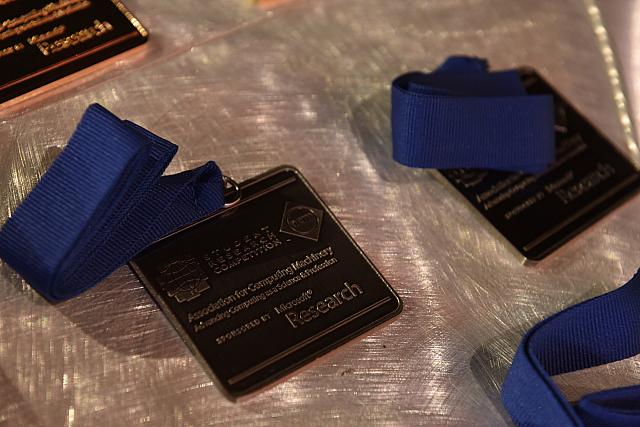
This year, SC received 64 submissions that went through a rigorous review process. In the end, 25 Student Research Competition posters were accepted. The Student Research Competition includes travel support for all SC15 participating students as well as cash awards to the finalists. This award is co-sponsored by Microsoft Research.

The first place winners will move on to the Student Research Competition grand finals next year. According to SC15 Posters Chair, Manish Parashar, "The poster session is a very important activity where the poster authors and audiences enjoy face-to-face discussion on their technologies for a broader audience and great exposure for their work."

Best SC15 Poster
SC's Manish Parashar congratulates Timothy I. Mattox who was part of the team that won for Best Poster.

Parashar then introduced the overall winner of the SC15 Best Poster Award as "Parallelization, Acceleration, and Advancement of Dissipative Particle Dynamics (DPD) Methods".

Authors are as follows:

  • Timothy I. Mattox - Engility Corporation
  • James P. Larentzos - Engility Corporation 
  • Christopher P. Stone - Computational Science and Engineering, LLC.
  • Sean Ziegeler - Engility Corporation; John K. Brennan - U.S. Army Research Laboratory
  • Martin Lísal - Institute of Chemical Process Fundamentals of the Academy of Sciences of the Czech Republic and J. E. Purkyne University.

The other SC15 Poster finalists:

  • Performance, Power, and Energy of In-Situ and Post-Processing Visualization: A Case Study in Climate Simulation - with Vignesh Adhinarayanan - Virginia Polytechnic Institute and State University as lead author.
  • Development of Explicit Moving Particle Simulation Framework and Zoom-Up Tsunami Analysis System - with Kohei Murotani - University of Tokyo as lead author.
  • Efficient Large-Scale Sparse Eigenvalue Computations on Heterogeneous Hardware - with Moritz Kreutzer - Friedrich-Alexander University Erlangen-Nürnberg as lead author.
  • Memory Hotplug for Energy Savings of HPC systems - with Shinobu Miwa - Hiroki Honda University of Electro-Communications as lead author.
  • Benchmark Simulation and Experimental Testbed Studies of AWGR-Based, Multi-Layer Photonic Interconnects for Low- Latency, Energy-Efficient Computing Architectures - with Paolo Grani - University of California Davis as lead author.
  • Large-Scale and Massively Parallel Phase-Field Simulations of Pattern Formation in Ternary Eutectic Alloys - with Johannes Hötzer - Karlsruhe University of Applied Sciences as lead author.
SC15 Student Research Awards.
ACM Student Research Winners
ACM CEO, Bobby Schnabel and ACM President, Alex Wolf presented the winners of the ACM Student Research Competition and took part in also introducing both the 2015 Undergraduate and Graduate Student Research Award finalists:

The SC15 Undergraduate Student Research Award Finalists on stage with members of the Awards Committee.
    • Third Place: ”Modeling the Impact of Thread Configuration on Power and Performance of GPUs” by Tiffany A. Connors from Texas State University.
    • Second Place: ”Optimization Strategies for Materials Science Applications on Cori: An Intel Knights Landing, Many Integrated Core Architecture” by Luther D. Martin from National Energy Research Scientific Computing Center.
    • First Place: ”Lessons from Post-Processing Climate Data on Modern Flash-Based HPC Systems” by Adnan Haider from the Illinois Institute of Technology.

    Then the 2015 Graduate Student Research Award finalists were presented:

    The SC15 Graduate Student Research Award Finalists on stage with members of the Awards Committee .
      • Third Place: “High Performance Model Based Image Reconstruction” by Xiao Wang from Purdue University.
      • Second Place: “Efficient Multiscale Platelets Modeling Using Supercomputers” by Na Zhang from Stony Brook University.
      • First Place: "AccFFT: A New Parallel FFT Library for CPU and GPU Architectures” by Amir Gholami from the University of Texas at Austin.

      Scientific Visualization and Data Analytics Showcase
      This is the second year of the new format for the Scientific Visualization and Data Analytics Showcase. Six finalists competed for the Award and presented their movie during a dedicated session.

      Movies were judged based on the following:
      • Quality
      • Creativity
      • Innovation
      • How each enables scientific discovery 

      Members of the winning team accept their award.

      The Scientific Visualization and Data Analytics Award went to “Visualization of Ocean Currents and Eddies in a High-Resolution Ocean Model," authored by: Francesca Samsel, Mark Petersen, Terece Turton. Gregory Abram, James Ahrens, and David Rogers. 


      The other finalists were as follows:
        • "Gasoline Compression Ignition: Optimizing Start of Injection Time" with Joseph Insley as the lead author.
        • "Visualization Of Airflow Through The Human Respiratory System: The Sniff" with Fernando Cucchietti as the lead author.
        • "Visualization of a Tornado-Producing Thunderstorm: A Study of Visual Representation" with David Bock as the lead author.
        • "Extreme Multi-Resolution Visualization: A Challenge On Many Levels" with Joanna Balme as the lead author.
        • "Chemical Visualization of Human Pathogens: The Retroviral Capsids" with Juan Perilla as the lead author.

        IEEE TCSC Award for Excellence in Scalable Computing for Early Career Researchers
        The IEEE TCSC Award for Excellence in Scalable Computing for Early Career Researchers recognizes individuals who have made outstanding and potentially long-lasting contributions to the field within five years of receiving their PhD.

        The winners of the IEEE TCSC Award for Excellence in Scalable Computing for Early Career Researchers with members of the SC Awards Committee.

        The following were the winners as announced by Manish Parashar who is also the SC15 Chair of the Award selection committee:
        •    Ilkay Altintas, San Diego Supercomputer Center, UC San Diego
        •    Aydin Buluç, Computational Research Division, Berkeley Lab (LBNL)
        •    Kurt B. Ferreira, Sandia National Laboratories       
               

        ACM/IEEE George Michael Memorial HPC Fellowship
        The George Michael Memorial HPC Fellowship honors exceptional PhD students in our field. These Fellowships are sponsored by ACM, the IEEE Computer Society, and the SC Conference, and include a $5,000 honorarium. The George Michael Memorial HPC Fellowship Chair is Barbara Horner-Miller.

        The 2015 George Michael Memorial HPC Fellowship winners are:

        Maciej Besta (on the left) and Dhairya Malhotra accept their certificates as winners of the 2015 George Michael Memorial HPC Fellowship from Barbara Horner-Miller, the George Michael Memorial HPC Fellowship Chair.
        • Maciej Besta from ETH Zurich for his project "Accelerating Large-Scale Distributed Graph Computations."
        • Dhairya Malhotra from the University of Texas at Austin, for his project "Scalable Algorithms for Evaluating Volume Potentials."

        ACM Gordon Bell Prize
        Gordon Bell
        The ACM Gordon Bell Prize is awarded for outstanding team achievement in HPC. The purpose of the award is to track the progress of parallel computing. Particular emphasis is placed on rewarding innovation in HPC to advance science, engineering and large-scale data analytics.

        According to Cherri Pancake, ACM Awards Chair, "Solving a scientific or engineering problem is important, but performance as well as scientific outcomes are needed to win this prize." She continued, "Finalists were chosen on the basis of performance measurements already achieved when the papers were submitted.  Teams present their work in two sessions during the conference.  The winning team receives a $10,000 stipend."

        Members of the winning Gordon Bell prize team on stage with some of the SC Awards Committee.

        The winning selection was “An Extreme-Scale Implicit Solver for Complex PDEs: Highly Heterogeneous Flow in Earth’s Mantle” in the category Scalabilty and was authored by:

        • Johann Rudi - The University of Texas at Austin
        • A. Cristiano I. Malossi - IBM Corporation
        • Tobin Isaac - The University of Texas at Austin
        • Georg Stadler - Courant Institute of Mathematical Sciences
        • Michael Gurnis - California Institute of Technology
        • Peter W. J. Staar - IBM Corporation
        • Yves Ineichen - IBM Corporation
        • Costas Bekas - IBM Corporation
        • Alessandro Curioni - IBM Corporation
        • Omar Ghattas - The University of Texas at Austin

        Listed below are the other finalists who also deserve congratulations:

        • “Massively Parallel Models of the Human Circulatory System” with research led by Amanda Randles - Duke University.
        • “An Extreme-Scale Implicit Solver for Complex -PDEs: Highly Heterogeneous Flow in Earth’s Mantle” with research led by Johann Rudi - The University of Texas at Austin.
        • “The In-Silico Lab-on-a-Chip: Petascale and High-Throughput Simulations of Microfluidics at Cell Resolution - with research led by Diego Rossinelli - ETH Zurich.
        • “Pushing Back the Limit of Ab-initio Quantum Transport Simulations on Hybrid Supercomputers" - with research led by Mauro Calderara - ETH Zurich.
        • “Implicit Nonlinear Wave Simulation with 1.08T DOF and 0.270T Unstructured Finite Elements to Enhance Comprehensive Earthquake Simulation” - with research led by Tsuyoshi Ichimura - University of Tokyo.

        This completes the summary of the SC15 Awards Ceremony.  Congratulations to all finalists and winners. Check back here for more conference updates or click here to view the SC16 website.

        Tuesday, December 1, 2015

        SC15 Awards Recap: Part 1


        Once again, the SC Awards Ceremony was an entertaining event and one of the many highlights of conference week. This year, the SC15 Award Co-Chairs were Padma Raghavan and Franck Cappello who helped open the SC15 Awards Ceremony

        According to Cappello, “The awards are very important for the SC conference series. They celebrate the best and the brightest of High Performance Computing [HPC].  The selection of the finalists and winners follow a very strict and codified process, involving many members of the program committee.”

        SC15 Award Co-Chairs were Padma Raghavan and Franck Cappello.

        He continued, “Awards are not just plaques or certificates. They define excellence. They set the bar for the years to come. They are a very powerful inspiration for young and senior researchers.”

        Raghavan added that even being an award finalist at SC15 is already an achievement in itself. Following is a brief summary of some of the SC15 award winners.

        SC15 Student Cluster Competition
        The Student Cluster Competition is comprised of two awards: the first for the Highest LINPACK and the 2nd for the Overall Winner. These awards showcase student expertise in a friendly yet spirited competition.   It’s a non-stop, real-time, 48-hour challenge where students race to assemble a small cluster at SC15 to demonstrate the greatest sustained performance across a series of applications.

        The students partner with vendors to design and build a cutting-edge cluster from commercially available components, not to exceed a 3120-watt power limit and work with application experts to tune and run the competition codes.  The Student Cluster competition is supported by Allinea and Schlumberger.

        The first Student Cluster Competition award - Highest LINPACK Benchmark - went to Team TUMuch Phun, Technische Universität from München, Germany.       

        Team TUMuch Phun, Technische Universität from München, Germany, receive the Highest LINPACK Benchmark award from SC15 Student Cluster Competition Chair, Hai-Ah Nam (far right). 

        The Overall Student Cluster Competition winner was determined based on a combined score for correctly completed workload, benchmark performance, demonstrated understanding of architecture and performance through profiling and analysis, and interviews. This year’s winner was Team Diablo from Tsinghua University in China.

        Team Diablo, Tsinghua University in China, celebrate winning the SC15 Student Cluster Competition.

        Technical Papers Program
        Jeffrey S. Vetter, SC15 Technical Program Chair, presents interesting data from this year’s submissions during the SC15 awards ceremony in Austin, Texas.

        The Technical Papers Program is one of SC’s most valued components.  Each year SC receives submissions of original research that introduce new ideas to the field and stimulate future trends in HPC.  As in previous years, it was a tough competition, with 361 paper submissions covering a wide range of research interests and topics.

        The committee met for two days in June to review the Papers. At the conclusion of the meeting, the committee had accepted 78 papers, which is a 22 percent acceptance rate.  Of the 78 papers, nine have been selected as finalists for the Best Paper and Best Student Paper awards.

        Please note,  all technical papers are available at the ACM Digital Library and can be accessed by clicking here.

        Best Student Paper

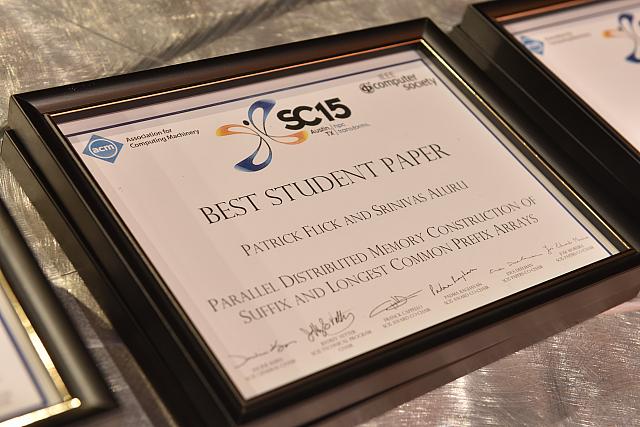
        "Parallel Distributed Memory Construction of Suffix and Longest Common Prefix Arrays” by Patrick Flick and Srinivas Aluru was selected as the SC15 best student paper.

        Patrick Flick’s and Srinivas Aluru’s winning paper proposes a novel algorithm for the suffix array problem. The performance results are very impressive and demonstrate a hundred fold improvement over existing methods. The algorithm itself has a potential broad impact on the field of genomics.

        The three other finalists were:
        • Adaptive and Transparent Cache Bypassing for GPUs - with Ang Li from Eindhoven University of Technology as the lead author.
        • A Case for Application-Oblivious Energy - Efficient MPI Runtime- with Akshay Venkatesh - Ohio State University as the lead author.
        • GraphReduce: Processing Large-Scale Graphs on Accelerator - Based Systems - with Dipanjan Sengupta - Georgia Institute of Technology as the lead author

        Best Overall Paper
         
        The SC15 Best Paper, ”ScaAnalyzer — A Tool to Identify Memory Scalability Bottlenecks in Parallel Programs” by Xu Liu and Bo Wu.

        Xu Liu’s and Bo Wu’s winning paper proposes methods and tools that isolate the causes of memory bottlenecks in both hardware and software in advanced computing systems. The committee felt the fundamental contributions address the memory wall problem and could have wide applicability in software development at Exascale.

        The Best Paper authors (with certificates from left) Bo Wu and Xu Liu receive their awards from members of the SC15 Awards Committee who are (from left) Padma Raghavan, Eva Deelman and José Moreira, co-chairs of the SC15 Technical Papers Committee, and Franck Cappello.

        The other finalists were:
        • Massively Parallel Phase-Field Simulations for Ternary Eutectic Directional Solidification - with Martin Bauer - FAU Erlangen Nuremberg as the lead author.
        • Efficient Implementation of Quantum Materials Simulations on Distributed CPU-GPU Systems - with Raffaele Solcà - ETH Zurich as the lead author.
        • Adaptive and Transparent Cache Bypassing for GPU's - with Ang Li - Eindhoven University of Technology as lead author.
        • Exploiting Asynchrony from Exact Forward Recovery for DUE in Iterative Solvers - with Luc Jaulmes - Barcelona Supercomputing Center as the lead author.
        • PGX.D: A Fast Distributed Graph Processing System - with Sungpack Hong - Oracle Corporation as the lead author. 

        Check back here for additional coverage of other SC15 award winners in the near future.

        Tuesday, November 24, 2015

        Australian Teens Pick Up Supercomputing Knowledge, Souvenirs on Trip to SC15

        The Australian group visits the U.S. Department of Energy booth at SC15.
        Eight students from three specialized science schools in eastern Australia spent a week at the SC15 conference in Austin, Texas, with the goal of bringing home more than the usual conference swag -- they came looking for information that will help them with computing projects at their schools and experiences that will spur their classmates’ interest in high performance computing.

        The students were selected from the Queensland Academy of Science, Mathematics and Technology (QASMT), and the Faith Lutheran College, both in Brisbane, and the John Monash Science School in Melbourne. The students, all but one are in their 10th school year, were part of a program created several years ago by Prof. David Abramson of the University of Queensland.

        “A big highlight for me was a panel presentation on post-Moore’s Law looking at digital, quantum and neuromorphic computing from the perspectives of different scientists,” said Dylan Sanusi-Goh of the John Monash Science School (JMSS). “I also went to a Microsoft talk on quantum programming and then they walked me through how to do it. Here you get to do something you couldn’t do otherwise.”

        Paro Mitchell of JMSS said she was interested in how computers are getting much faster, but also wanted to know what will happen after Moore’s Law no longer applies, and the doubling of computing power per processor every 18 months which has driven the industry for decades comes to an end. “Supercomputers are such a great technology and I wanted to know what we are using it for.”

        One area of research benefiting from supercomputing -- the merging of black holes, their interactions and the gravitational waves that are generated caught the imagination of Olivia MacKenzie of the Queensland Academy.

        Jess Woolley of JMSS said that although she hasn’t done any programming, she was learning a lot as the week progressed. At a visit to the nearby Texas Advanced Computing Center, she was excited to see an actual supercomputer and “how big and how loud they are, and see what’s inside of them.”

        And learning about a wide range of science disciplines, possibilities and tools was one of the goals of the trip, said teacher Robyn Simpson of QASMT.

        Linda McIver, a teacher at JMSS, said the students were selected partly for what they would bring back to get their schools excited about computing.

        And the student have clear projects at their home institutions. At each of the three schools, they are installing sensors to measure different conditions in the buildings to make them both more efficient and more comfortable.

        Jack Stubbs of the Queensland Academy said his group is rolling out eight sensors to help detect when and where the lights, air conditioning and heating should be on or off, “so we can be more eco-friendly.”

        Sanusi-Goh said his group is installing sensors to measure light, sound, temperature and humidity in their school to improve future classroom design. His school consists of one building with three levels, and often the lower one is too cold while the top floor is too warm.

        Woolley added that her group is interested in developing a system to better regulate classroom temperatures, which are set to 23 degrees Celsius, but the current system doesn’t take into account the effects of room occupancy.

        Travis Jacob, the lone 11th year student in the group, and schoolmate Harrison Cook are using a few sensors to measure carbon dioxide levels to see how they rise and fall during the day at the Faith Lutheran College. They want to see if CO2 levels can be used to indicate room occupancy.

        Teacher Stephen Blair of  Faith Lutheran College said the projects help show the students the value to solid data when making their cases about classroom conditions to school administrators and pointing out ways to improve their environments.

        The students received travel support from Monash University, the University of Queensland, their schools and they have corporate sponsorship from SGI and ScaleMP.

        Friday, November 20, 2015

        China’s Team Diablo Turns Up the Heat to Win SC15 Student Cluster Competition

        Tsinghua University Claims Third Cluster Competition Title this Year
        Team Diablo from Tsinghua University, the overall winners of the SC15 Student Cluster Competition.
        Team Diablo, a team of undergraduate students from Tsinghua University in China, won the top prize in the Student Cluster Competition at the SC15 conference in Austin, Texas. A team from Germany, Team TUMuch Phun from the Technical University of Munich, won the award for achieving highest performance for the Linpack benchmark.

        For the Tsinghua University team, this was their third win, coming on the heels of victories at the International Supercomputing Conference in Germany and the Asia Supercomputing Community Student Supercomputer Challenge.

        When they were announced as SC15 winners at the Thursday, Nov. 19, awards session, the team let out a whoop and went to the stage to collect their certificates.

        “After they announced it, we were really excited,” said Youwei Zhou, a senior undergraduate student and team spokesman. “Our secret is teamwork and each member is capable of understanding the hardware and software. When we get stuck on a problem and cannot progress, we always figure it out with more people working on it. We also find potential performance increases this way.”

        Zhou also said the each of this year’s winning teams from his university consisted of different students.

        The Student Cluster Competition, which debuted at SC07 in Reno and has since been replicated in Europe, Asia and Africa, is a real-time, non-stop, 48-hour challenge in which teams of six undergraduates assemble a small cluster at SC15 and race to complete a real-world workload across a series of scientific applications, demonstrate knowledge of system architecture and application performance, and impress HPC industry judges.  

        The students partner with vendors to design and build a cutting-edge cluster from commercially available components, not to exceed a 3120-watt power limit and work with application experts to tune and run the competition codes.

        The award for Student Cluster Competition Overall Winner is based on the combined score for correctly completed workload, benchmark performance, demonstrated understanding of architecture and performance through profiling and analysis, and interviews.

        In addition to the teams from China and Germany, the SC15 Student Cluster Competition line-up included:
        ●      Team Desert Heat, Arizona Research Computing, United States
        ●      Illinois Institute of Technology, United States
        ●      National Tsing Hua University, Taiwan
        ●      Northeastern University, United States
        ●      Pawsey Supercomputing Centre, Australia
        ●      Universidad EAFIT, Colombia
        ●      University of Oklahoma, United States

        The Student Cluster Competition is part of the Students@SC Program. Funding for the SC15 Student Cluster Competition was provided by IEEE/ACM SC15 and supported by Allinea and Schlumberger.

        Thursday, November 19, 2015

        SC15 Breaks Exhibits and Attendance Records While in Austin, Texas

        Noted science communicator and award-winning actor Alan Alda gives the SC15 Keynote Address in Austin, TX, where record-breaking attendance reached approximately  13,000 people.
         Media Contact: Brian Ban (773) 454-7423 or BrianBan@SC15Austin.com

        Austin, TX - SC15, the 27th anniversary conference of high performance computing (HPC), networking, storage and analysis, celebrated the contributions of researchers and scientists - from those just starting their careers to those whose contributions have made lasting impacts.

        The SC15 Exhibit Hall broke records in Austin, TX. (Click photo to enlarge.)
        The conference drew a record-breaking 12,914+ registered attendees (as of data collected on 11/20) and featured a technical program spanning six days. The exhibit hall featured 343 exhibitors from industry, academia and research organizations from around the world.

        Crowds rushed to the SC15 Exhibit Hall between engaging Technical Sessions.
        “In a world of ever-growing, complex problems, high performance computing has a plethora of opportunities to impact lives across multiple fields,” said Jackie Kern, SC15 General Chair from the University of Illinois at Champaign-Urbana.

        SC15 found its home in Austin, TX - pictured here at dawn.
        She continued, “No longer is high performance computing reserved for only the biggest corporations in the world. It is now trickling down to smaller, medium-sized firms, which is only increasing its impact. This conference brings together the best research and industry minds in the world for one packed week of sharing ideas, networking, and education.”

        SC15 General Chair Jackie Kern being interviewed by Austin-CBS affiliate KEYE in the Exhibit Hall.
        According to Kern, the SC15 Exhibition was sold out and the industry-focused exhibit space was the largest to date in the history of the conference. The 217 industry-focused exhibits also marks a new SC15 record. In addition to record-breaking exhibit space, there were a total of 43 first-time exhibitors and 113 international exhibitors from 23 countries (outside the US).  In all, there was a total of approx. 137,000 net square feet of exhibit space and 343 industry and research organizations

        SCinet - once again, the world's fastest conference computer network.
        During the conference, Austin also became the hub for the world’s fastest conference computer network - SCinet (SC15’s custom network) which made 1.62 (16 100G + 2 10G) Terabits of bandwidth available to exhibitors and attendees.  The network featured 84 miles of fiber deployed throughout the convention center and $18 million in loaned equipment.  It was all made possible by 130 volunteers representing global organizations spanning academia, government and industry.

        Noted science communicator and award-winning actor Alan Alda opened the SC15 Technical Program with a keynote speech focusing on the role of science in our society and the intersection of science and computing to a full house of approximately 3,000 people in Austin, Texas on November 17th.

        Jeffrey S. Vetter, the SC15 Technical Program Chair, takes the stage.
        The Technical Program again offered the highest quality in original HPC research. The SC workshops set a new record with more than 2,000 attendees. There were 10 Best Paper Finalists and 5 Gordon Bell Finalists. These submissions represent the best of the best in a wide variety of research topics in HPC.

        Congrats to the 2015 Gordon Bell Prize Award winners. The team received their award at SC15 for using innovative algorithms & implicit solvers to realistically simulate current conditions of the Earth’s interior for the first time. Their work could herald a major step toward more accurately predicting earthquakes and volcanic eruptions.
        Overall Stats on Tech Program Tracks:

        •    75 Birds-of-a-Feathers
        •    78 Papers
        •    12 Panels
        •    135 Posters  
        •    41 Tutorials
        •    42 Workshops
        •    14 Invited Speakers
        •    14 Doctoral Showcase Presentations
        •    10 Emerging Technology Presentations

        Intel executive Diane Bryant addresses the crowd at the HPC Matters Plenary.
        For the second year, SC featured an opening “HPC Matters” plenary that this year was led by Diane Bryant, senior vice president and general manager of Intel’s Data Center Group, who discussed how next-generation supercomputers are transforming HPC.  She further identified exciting opportunities for advancing scientific research and discovery to deliver far-reaching impacts on society.

        As part of this Plenary, Intel announced a $300,000 scholarship per-year for five years for women/minorities with STEM undergraduate degrees to fund fellowships for those pursuing PhD's degrees in computational and data science.  This commitment is in honor of Intel's third CEO Andrew Grove. 

        The entire Plenary is available online and available by clicking here.

        SC16 will be held next November 13th-18th in Salt Lake City, Utah.  For more details, click here.

        About SC15
        SC15, sponsored by ACM (Association for Computing Machinery) and IEEE Computer Society offers a complete technical education program and exhibition to showcase the many ways high performance computing, networking, storage and analysis lead to advances in scientific discovery, research, education and commerce. This premier international conference includes a globally attended technical program, workshops, tutorials, a world class exhibit area, demonstrations and opportunities for hands-on learning. For more information on SC15, please visit http://www.sc15.supercomputing.org/, or contact communications@info.supercomputing.org for more information.

        About ACM
        ACM, the Association for Computing Machinery www.acm.org, is the world’s largest educational and scientific computing society, uniting computing educators, researchers and professionals to inspire dialogue, share resources and address the field’s challenges. ACM strengthens the computing profession’s collective voice through strong leadership, promotion of the highest standards, and recognition of technical excellence. ACM supports the professional growth of its members by providing opportunities for life-long learning, career development, and professional.