Showing posts with label HPC Matters. Show all posts

Tuesday, December 1, 2015

SC15 Awards Recap: Part 1


Once again, the SC Awards Ceremony was an entertaining event and one of the many highlights of conference week. This year, the SC15 Award Co-Chairs were Padma Raghavan and Franck Cappello who helped open the SC15 Awards Ceremony

According to Cappello, “The awards are very important for the SC conference series. They celebrate the best and the brightest of High Performance Computing [HPC].  The selection of the finalists and winners follow a very strict and codified process, involving many members of the program committee.”

SC15 Award Co-Chairs were Padma Raghavan and Franck Cappello.

He continued, “Awards are not just plaques or certificates. They define excellence. They set the bar for the years to come. They are a very powerful inspiration for young and senior researchers.”

Raghavan added that even being an award finalist at SC15 is already an achievement in itself. Following is a brief summary of some of the SC15 award winners.

SC15 Student Cluster Competition
The Student Cluster Competition is comprised of two awards: the first for the Highest LINPACK and the 2nd for the Overall Winner. These awards showcase student expertise in a friendly yet spirited competition.   It’s a non-stop, real-time, 48-hour challenge where students race to assemble a small cluster at SC15 to demonstrate the greatest sustained performance across a series of applications.

The students partner with vendors to design and build a cutting-edge cluster from commercially available components, not to exceed a 3120-watt power limit and work with application experts to tune and run the competition codes.  The Student Cluster competition is supported by Allinea and Schlumberger.

The first Student Cluster Competition award - Highest LINPACK Benchmark - went to Team TUMuch Phun, Technische Universität from München, Germany.       

Team TUMuch Phun, Technische Universität from München, Germany, receive the Highest LINPACK Benchmark award from SC15 Student Cluster Competition Chair, Hai-Ah Nam (far right). 

The Overall Student Cluster Competition winner was determined based on a combined score for correctly completed workload, benchmark performance, demonstrated understanding of architecture and performance through profiling and analysis, and interviews. This year’s winner was Team Diablo from Tsinghua University in China.

Team Diablo, Tsinghua University in China, celebrate winning the SC15 Student Cluster Competition.

Technical Papers Program
Jeffrey S. Vetter, SC15 Technical Program Chair, presents interesting data from this year’s submissions during the SC15 awards ceremony in Austin, Texas.

The Technical Papers Program is one of SC’s most valued components.  Each year SC receives submissions of original research that introduce new ideas to the field and stimulate future trends in HPC.  As in previous years, it was a tough competition, with 361 paper submissions covering a wide range of research interests and topics.

The committee met for two days in June to review the Papers. At the conclusion of the meeting, the committee had accepted 78 papers, which is a 22 percent acceptance rate.  Of the 78 papers, nine have been selected as finalists for the Best Paper and Best Student Paper awards.

Please note,  all technical papers are available at the ACM Digital Library and can be accessed by clicking here.

Best Student Paper
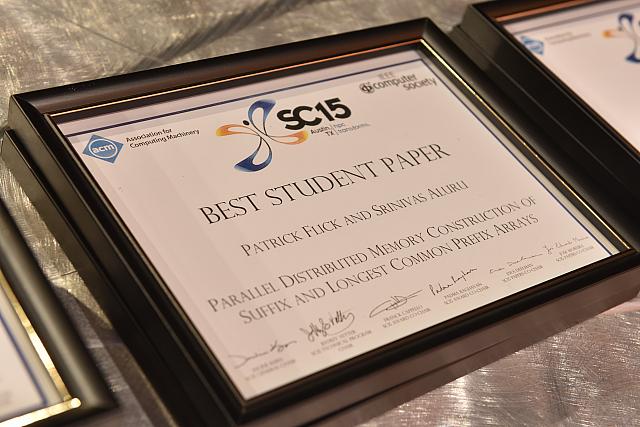
"Parallel Distributed Memory Construction of Suffix and Longest Common Prefix Arrays” by Patrick Flick and Srinivas Aluru was selected as the SC15 best student paper.

Patrick Flick’s and Srinivas Aluru’s winning paper proposes a novel algorithm for the suffix array problem. The performance results are very impressive and demonstrate a hundred fold improvement over existing methods. The algorithm itself has a potential broad impact on the field of genomics.

The three other finalists were:
  • Adaptive and Transparent Cache Bypassing for GPUs - with Ang Li from Eindhoven University of Technology as the lead author.
  • A Case for Application-Oblivious Energy - Efficient MPI Runtime- with Akshay Venkatesh - Ohio State University as the lead author.
  • GraphReduce: Processing Large-Scale Graphs on Accelerator - Based Systems - with Dipanjan Sengupta - Georgia Institute of Technology as the lead author

Best Overall Paper
 
The SC15 Best Paper, ”ScaAnalyzer — A Tool to Identify Memory Scalability Bottlenecks in Parallel Programs” by Xu Liu and Bo Wu.

Xu Liu’s and Bo Wu’s winning paper proposes methods and tools that isolate the causes of memory bottlenecks in both hardware and software in advanced computing systems. The committee felt the fundamental contributions address the memory wall problem and could have wide applicability in software development at Exascale.

The Best Paper authors (with certificates from left) Bo Wu and Xu Liu receive their awards from members of the SC15 Awards Committee who are (from left) Padma Raghavan, Eva Deelman and José Moreira, co-chairs of the SC15 Technical Papers Committee, and Franck Cappello.

The other finalists were:
  • Massively Parallel Phase-Field Simulations for Ternary Eutectic Directional Solidification - with Martin Bauer - FAU Erlangen Nuremberg as the lead author.
  • Efficient Implementation of Quantum Materials Simulations on Distributed CPU-GPU Systems - with Raffaele Solcà - ETH Zurich as the lead author.
  • Adaptive and Transparent Cache Bypassing for GPU's - with Ang Li - Eindhoven University of Technology as lead author.
  • Exploiting Asynchrony from Exact Forward Recovery for DUE in Iterative Solvers - with Luc Jaulmes - Barcelona Supercomputing Center as the lead author.
  • PGX.D: A Fast Distributed Graph Processing System - with Sungpack Hong - Oracle Corporation as the lead author. 

Check back here for additional coverage of other SC15 award winners in the near future.

Friday, November 20, 2015

China’s Team Diablo Turns Up the Heat to Win SC15 Student Cluster Competition

Tsinghua University Claims Third Cluster Competition Title this Year
Team Diablo from Tsinghua University, the overall winners of the SC15 Student Cluster Competition.
Team Diablo, a team of undergraduate students from Tsinghua University in China, won the top prize in the Student Cluster Competition at the SC15 conference in Austin, Texas. A team from Germany, Team TUMuch Phun from the Technical University of Munich, won the award for achieving highest performance for the Linpack benchmark.

For the Tsinghua University team, this was their third win, coming on the heels of victories at the International Supercomputing Conference in Germany and the Asia Supercomputing Community Student Supercomputer Challenge.

When they were announced as SC15 winners at the Thursday, Nov. 19, awards session, the team let out a whoop and went to the stage to collect their certificates.

“After they announced it, we were really excited,” said Youwei Zhou, a senior undergraduate student and team spokesman. “Our secret is teamwork and each member is capable of understanding the hardware and software. When we get stuck on a problem and cannot progress, we always figure it out with more people working on it. We also find potential performance increases this way.”

Zhou also said the each of this year’s winning teams from his university consisted of different students.

The Student Cluster Competition, which debuted at SC07 in Reno and has since been replicated in Europe, Asia and Africa, is a real-time, non-stop, 48-hour challenge in which teams of six undergraduates assemble a small cluster at SC15 and race to complete a real-world workload across a series of scientific applications, demonstrate knowledge of system architecture and application performance, and impress HPC industry judges.  

The students partner with vendors to design and build a cutting-edge cluster from commercially available components, not to exceed a 3120-watt power limit and work with application experts to tune and run the competition codes.

The award for Student Cluster Competition Overall Winner is based on the combined score for correctly completed workload, benchmark performance, demonstrated understanding of architecture and performance through profiling and analysis, and interviews.

In addition to the teams from China and Germany, the SC15 Student Cluster Competition line-up included:
      Team Desert Heat, Arizona Research Computing, United States
      Illinois Institute of Technology, United States
      National Tsing Hua University, Taiwan
      Northeastern University, United States
      Pawsey Supercomputing Centre, Australia
      Universidad EAFIT, Colombia
      University of Oklahoma, United States

The Student Cluster Competition is part of the Students@SC Program. Funding for the SC15 Student Cluster Competition was provided by IEEE/ACM SC15 and supported by Allinea and Schlumberger.

Thursday, November 19, 2015

SC15 Breaks Exhibits and Attendance Records While in Austin, Texas

Noted science communicator and award-winning actor Alan Alda gives the SC15 Keynote Address in Austin, TX, where record-breaking attendance reached approximately  13,000 people.
 Media Contact: Brian Ban (773) 454-7423 or BrianBan@SC15Austin.com

Austin, TX - SC15, the 27th anniversary conference of high performance computing (HPC), networking, storage and analysis, celebrated the contributions of researchers and scientists - from those just starting their careers to those whose contributions have made lasting impacts.

The SC15 Exhibit Hall broke records in Austin, TX. (Click photo to enlarge.)
The conference drew a record-breaking 12,914+ registered attendees (as of data collected on 11/20) and featured a technical program spanning six days. The exhibit hall featured 343 exhibitors from industry, academia and research organizations from around the world.

Crowds rushed to the SC15 Exhibit Hall between engaging Technical Sessions.
“In a world of ever-growing, complex problems, high performance computing has a plethora of opportunities to impact lives across multiple fields,” said Jackie Kern, SC15 General Chair from the University of Illinois at Champaign-Urbana.

SC15 found its home in Austin, TX - pictured here at dawn.
She continued, “No longer is high performance computing reserved for only the biggest corporations in the world. It is now trickling down to smaller, medium-sized firms, which is only increasing its impact. This conference brings together the best research and industry minds in the world for one packed week of sharing ideas, networking, and education.”

SC15 General Chair Jackie Kern being interviewed by Austin-CBS affiliate KEYE in the Exhibit Hall.
According to Kern, the SC15 Exhibition was sold out and the industry-focused exhibit space was the largest to date in the history of the conference. The 217 industry-focused exhibits also marks a new SC15 record. In addition to record-breaking exhibit space, there were a total of 43 first-time exhibitors and 113 international exhibitors from 23 countries (outside the US).  In all, there was a total of approx. 137,000 net square feet of exhibit space and 343 industry and research organizations

SCinet - once again, the world's fastest conference computer network.
During the conference, Austin also became the hub for the world’s fastest conference computer network - SCinet (SC15’s custom network) which made 1.62 (16 100G + 2 10G) Terabits of bandwidth available to exhibitors and attendees.  The network featured 84 miles of fiber deployed throughout the convention center and $18 million in loaned equipment.  It was all made possible by 130 volunteers representing global organizations spanning academia, government and industry.

Noted science communicator and award-winning actor Alan Alda opened the SC15 Technical Program with a keynote speech focusing on the role of science in our society and the intersection of science and computing to a full house of approximately 3,000 people in Austin, Texas on November 17th.

Jeffrey S. Vetter, the SC15 Technical Program Chair, takes the stage.
The Technical Program again offered the highest quality in original HPC research. The SC workshops set a new record with more than 2,000 attendees. There were 10 Best Paper Finalists and 5 Gordon Bell Finalists. These submissions represent the best of the best in a wide variety of research topics in HPC.

Congrats to the 2015 Gordon Bell Prize Award winners. The team received their award at SC15 for using innovative algorithms & implicit solvers to realistically simulate current conditions of the Earth’s interior for the first time. Their work could herald a major step toward more accurately predicting earthquakes and volcanic eruptions.
Overall Stats on Tech Program Tracks:

•    75 Birds-of-a-Feathers
•    78 Papers
•    12 Panels
•    135 Posters  
•    41 Tutorials
•    42 Workshops
•    14 Invited Speakers
•    14 Doctoral Showcase Presentations
•    10 Emerging Technology Presentations

Intel executive Diane Bryant addresses the crowd at the HPC Matters Plenary.
For the second year, SC featured an opening “HPC Matters” plenary that this year was led by Diane Bryant, senior vice president and general manager of Intel’s Data Center Group, who discussed how next-generation supercomputers are transforming HPC.  She further identified exciting opportunities for advancing scientific research and discovery to deliver far-reaching impacts on society.

As part of this Plenary, Intel announced a $300,000 scholarship per-year for five years for women/minorities with STEM undergraduate degrees to fund fellowships for those pursuing PhD's degrees in computational and data science.  This commitment is in honor of Intel's third CEO Andrew Grove. 

The entire Plenary is available online and available by clicking here.

SC16 will be held next November 13th-18th in Salt Lake City, Utah.  For more details, click here.

About SC15
SC15, sponsored by ACM (Association for Computing Machinery) and IEEE Computer Society offers a complete technical education program and exhibition to showcase the many ways high performance computing, networking, storage and analysis lead to advances in scientific discovery, research, education and commerce. This premier international conference includes a globally attended technical program, workshops, tutorials, a world class exhibit area, demonstrations and opportunities for hands-on learning. For more information on SC15, please visit http://www.sc15.supercomputing.org/, or contact communications@info.supercomputing.org for more information.

About ACM
ACM, the Association for Computing Machinery www.acm.org, is the world’s largest educational and scientific computing society, uniting computing educators, researchers and professionals to inspire dialogue, share resources and address the field’s challenges. ACM strengthens the computing profession’s collective voice through strong leadership, promotion of the highest standards, and recognition of technical excellence. ACM supports the professional growth of its members by providing opportunities for life-long learning, career development, and professional.

Wednesday, November 18, 2015

Hear from NSF's Aaron Dubrow as He Lists 10 Ways Advanced Computing Catalyzes Science


Visualization of 3-D Cerebellar Cortex model generated by researchers Angus Silver and Padraig Gleeson from University College London. The NeuroScience Gateway was used for simulations. Credit: Angus Silver and Padraig Gleeson, University College London
When researchers need to compare complex new genomes; or map new regions of the Arctic in high-resolution detail; or detect signs of dark matter; or make sense of massive amounts of fMRI data, they turn to the high-performance computing and data analysis systems supported by the National Science Foundation (NSF).

High-performance computing (HPC) enables discoveries in practically every field of science - not just those typically associated with supercomputers like chemistry and physics - but also in the social sciences, life sciences and humanities.

By combining superfast and secure networks, cutting-edge parallel computing and analytics software, and advanced scientific instruments and critical datasets across the U.S., NSF's cyber-ecosystem lets researchers investigate questions that can't otherwise be explored.

NSF has supported advanced computing since its beginning and is constantly expanding access to these resources to help tens of thousands of researchers each year - from high school students to Nobel Prize winners -- at institutions large and small, regardless of geographic locality, expand the frontiers of science and engineering.

Click here for 10 examples of research -- enabled by advanced computing resources -- from across all of science.

Excerpted with permission from Aaron Dubrow, the National Science Foundation

Tuesday, November 17, 2015

Alan Alda Gives Inspiring Keynote to Open SC15 in Austin Today

Alan Alda gives the 2015 SC Keynote to more than 3,000 attendees on Nov. 17th in Austin. 
Noted science communicator and award-winning actor Alan Alda opened SC15 with keynote speech focusing on the role of science in our society and the intersection of science and computing to a full house of more than 3,000 people in Austin, Texas on Nov. 17.

SC15 Chair Jackie Kern
“High performance computing has a transformational impact on science in our society,” comments SC15 general chair Jackie Kern, University of Illinois at Urbana Champaign. “For decades scientists and engineers have relied on high performance computing to advance the state of the art in diverse fields ranging from healthcare and automotive safety to renewable energy. Computing is now fully integrated into the scientific discovery process, an equal partner with theory and experiment in improving the quality of life for all members of our global society.

She continues, "Mr. Alda’s focus on communicating the benefits of science to the public—and how we can all do this more effectively—makes him uniquely positioned to help SC continue to bridge the gaps in science understanding and highlight our role in the discovery process.”

To view the write up in the Austin Business Journal, click here.

Mr. Alda--actor, writer, science advocate, and Visiting Professor at Stony Brook University—shared his passion for science communication and its importance, drawing on his personal experiences including his 11 years as host of the TV series Scientific American Frontiers.

Throughout his 40-year career, he has won seven Emmys, six Golden Globes, and three Directors Guild of America awards for directing. Alda also hosted the 2010 PBS mini-series The Human Spark and wrote Radiance: The Passion of Marie Curie, a play about the personal life of the great scientist who discovered radium. He teamed up with PBS again in 2013 for Brains on Trial, a neurological look at brains in the court room.

A recipient of the National Science Board’s Public Service Award, Alda is a visiting professor at and founding member of Stony Brook University’s Alan Alda Center for Communicating Science, where he helps develop innovative programs on how scientists communicate with the public. He is also on the Board of Directors of the World Science Festival.

Monday, November 16, 2015

SC15 HPC Matters Plenary Session Available Now Online

SC15 just released the full HPC Matters Plenary on YouTube for all to access.  Watch as Jackie Kern, SC15 General Chair from the University of Illinois, introduces Diane Bryant who then discusses how next-generation supercomputers are transforming HPC and presents exciting opportunities to advance scientific research and discovery to deliver far-reaching impacts on society.


As part of this Plenary, Intel announced a $300,000 scholarship per year for five years for women/minorities with STEM undergraduate degrees to fund fellowships for those pursuing PhD's degrees in computational and data science.  This commitment is in honor of Intel's third CEO Andrew Grove.

 Making special appearances were Intel Fellows Mark Bohr, Matt Adiletta, Al Gara, Mark Seager, Bill Magro, and Pradeep Dubey.

Closing out the HPC Matters Plenary was Wilf Pinfold, HPC Matters Chair from Concurrent Systems. Wilf encouraged future engagement by the audience in the HPC Matters theme for the coming year.  To learn more about the HPC Matters Program, click here or to view the HPC Matters short, compelling videos, click here.

Sunday, November 15, 2015

Connecting Live in Austin with One of the Mosts Powerful Networks in the World

The SCinet network, SC’s Supercomputing Internet, is now live! On November 14, the Austin Convention Center became home to the fastest and most innovative computer network in the world built by volunteers, delivering more than 1.6 terabits per second of network bandwidth to the SC conference (SC15).

SCinet gives the SC conference attendees a unique chance to showcase and discover the latest research in HPC. By building the fastest, most innovative operational network possible every year, SCinet enables data-intensive research and live-use of high performing hardware to run multi-gigabit demonstrations, requiring a fast and robust infrastructure.

SC15 SCinet Contributors (click to enlarge).
“This network is unrivaled with regards to its capabilities and the broad-reaching influence, both nationally and internationally, to support demonstrations and experiments that could not be done easily in any other place. It’s a one-of-a-kind environment where research meets production,” says Davey Wheeler, SCinet Chair and Senior Network Engineer from the National Center for Supercomputing Applications (NCSA) at the University of Illinois at Urbana-Champaign (UIUC). “As the SCinet Chair leading the development of this network, this year is a culmination of 17 years of experience working on SCinet from year to year. It is humbling and honoring to be able to work aside these colleagues and see the tremendous talent, dedication, and creativity of the volunteers.”

SCinet is built by a team of expert volunteers from around the world, taking one year to design the network, three weeks to set it up, four days to operate it, and twenty-four hours to tear it down. Over 100 engineers from industry, academia and government institutions came together to build this network, using over $22 million in loaned equipment and over 89 miles of newly installed fiber optic cables.

“Having been the SCinet Chair for SC07 in Reno, I am intimately familiar with the incredible amount of planning and work that goes into creating what will be the most powerful network. Over 130 SCinet volunteers from more than 15 countries have worked energetically for the past year to provide wired and wireless access to our conference attendees, and the platform for our exhibitors to showcase bandwidth-driven HPC and cloud computing applications. SCinet continues to be a crucial part of SC and I am extremely grateful for their hard work,” says Jackie Kern, Director of IT Shared Services at UIUC and SC15 Conference Chair.

For SC15, SCinet has connected multiple 100 gigabit circuits, bringing an unprecedented 1.62 terabits per second of bandwidth to the Austin Convention Center. Lonestar Education and Research Network (LEARN) leads this effort in collaboration with leading national and international research networks and commodity providers. LEARN and SCinet supports the HPC community by providing multiple 100 gigabit waves and complementary capabilities throughout the SC15 conference events. 

In addition to the massive external capacity SCinet brings to the convention center, the network is also supporting research initiatives through a half-day workshop, Innovating the Network for Data-Intensive Science (INDIS); and the Network Research Exhibition (NRE). SCinet organizes the INDIS workshop to discuss technical papers and show floor demonstrations dedicated to high performance networking technologies, innovations, protocols, hardware, and much more.

Further, SCinet is providing the wireless connectivity for more than 11,000 expected conference attendees throughout the conference areas. The SCinet team built the SC15 wireless network using 339 wireless access points to support more than 4,000 simultaneous users on the conference wifi. The wireless network will include support for eduroam (education roaming) service, which allows users (researchers, teachers, students, and staff) from participating institutions to securely access the protected wireless network using their home organization’s login credentials.

SCinet is the result of the hard work and significant contributions of many government, research, education and corporate collaborators who have volunteered time, equipment and expertise to ensure SC15’s success. This year, SCinet continued the Contributors Program and we would like to give a special thank you to all SCinet contributors and volunteers!

Platinum contributors: CenturyLink, Ciena, ESnet, Infinera, Internet2, Juniper Networks, and Lonestar Education and Research Network (LEARN).

Gold contributors: Brocade, Cisco, and Gigamon.

Silver contributors: Alcatel-Lucent, Arista, Austin Convention Center, Dell, Greater Austin Area Telecommunications Network (GAATN), inMon, IXIA, Reservoir Labs, Spirent, and The University of Texas System.

Bronze contributors: CABLExpress, Commscope, Splunk, Verisign, and Viavi Solutions.

Volunteers from the following organizations supporting the development and deployment of SCinet: Alcatel-Lucent, Army Research Laboratory, CABLExpress Corporation, CENIC, CenturyLink, Ciena, Cisco, Clemson University, DFN-Verein, DataDirect Networks, Dell Research, Energy Sciences Network (ESnet), Florida LambdaRail (FLR), Freelance, Georgia Institute of Technology, Idaho State University, InMon Corporation, Indiana University, Indiana University GlobalNOC, Indiana University of Pennsylvania, Infinera, Internet Consulting of Vermont, Internet2, JDSU, Lawrence Livermore National Laboratory, Lonestar Education and Research Network (LEARN), Louisiana Optical Network Initiative (LONI), Louisiana State University, the National Center for Supercomputing Applications, National Oceanic and Atmospheric Administration (NOAA), Pennsylvania State University, Purdue University, REANNZ, Radware, Reservoir Labs, SURFnet, Sandia National Laboratories, The University of Texas at Austin, University Corporation for Atmospheric Research, University of Amsterdam, University of California, San Diego, University of Colorado Boulder, University of Heidelberg, University of Illinois at Urbana-Champaign, University of Michigan, University of Oklahoma, University of Pittsburgh, University of Tennessee, Knoxville, University of Texas, University of Wisconsin-Madison, Utah Education Network, and Virginia Polytechnic Institute and State University.

If you’re interested in volunteering for SCinet or participating in the Contributor’s Program for SC16, please email scinet@info.supercomputing.org.

HPCwire Interviews Diane Bryant On Eve of HPC Matters Plenary

HPC Matters Plenary Speaker Diane Bryant
Thomas Ayres and Tiffany Trader for HPCwire

Back in September, the news broke that Intel’s Senior Vice President Diane Bryant was named the HPC Matters plenary speaker for the SC15 conference taking place in Austin, Texas.

The theme for this year’s HPC Matters program is “Fueling the Transformation” and Bryant, along with multiple industry luminaries, will be taking the stage before the SC15 opening gala on November 16 to discuss the myriad of ways that HPC is transforming lives.

Bryant leads Intel’s datacenter business unit, one of the chipmaker’s strongest segments. This year, FORTUNE magazine named Bryant to its Most Powerful Women in Business list. Criteria for selection to this prominent listing includes the importance of the woman’s business in the global economy, health and direction of the business, career arc, and cultural influence.

This dovetails well with Bryant’s role as speaker for this year’s HPC Matters plenary. The HPC Matters program, launched by the SC program committee two years ago, rests on four pillars: influencing daily lives, science and engineering, economic impact, and education.

Bryant speaks frequently on all of these issues and has been especially prominent in promoting the benefits of diversity in the workplace. For the upcoming HPC Matters plenary, Bryant will draw on her experience running Intel’s datacenter group, which includes the HPC business segment and products ranging from high-end coprocessors for supercomputers, to big data analytics solutions, to high-density systems for the cloud. In the exclusive interview to follow, she shares her thoughts on where she sees HPC heading in the upcoming years, why it’s an important topic in our world, and how her career at Intel has shaped her views on HPC. Following is the interview:

HPCwire: What key points are you going to touch on in your presentation?
Diane Bryant: We are in the midst of an unprecedented change in High Performance Computing. Everything about how HPC systems are used and built is going to change over the next decade. HPC must support more complex models with more and more data, and enable new usages as industries realize the benefits of very powerful real-time analytics.  To meet these needs, HPC must achieve exascale performance and beyond, while expanding access to more users.  This will require a transformation of not only the systems, but the entire solution stack.

How does HPC matter to you?
Diane Bryant: As an engineer, what excites me is seeing how information technology is used to solve real world problems.  HPC is a transformational capability helping solve society’s most pressing challenges.  Look at the improvements in life science and precision medicine that have really been enabled by researchers and physicians gaining access to more powerful supercomputers.  Seeing industry after industry take these tools with Intel technology as their foundation and use them to improve lives and drive economic growth is tremendously gratifying and exciting to all of us who work to push IT forward.

Click here to go to the full HPCwire article.

Saturday, November 14, 2015

An Elite Group: the SC Perennials

Do you know the SC Perennials?

Do you know how to recognize them at SC15?

Well, here's a hint. 

You can recognize that select group of 18 individuals who will be making their 28th consecutive appearance at the SC conference, by the unique lapel pin bestowed upon each of them (listed below).

If you see someone wearing this lapel pin, you don't have to salute.  No need to buy them a drink (unless of course you feel strongly about it).  And most of all, you should not refer to them as, "old timers".

The SC Perennials are very young at heart, and we stand tall with our motto, "We Keep Coming Back."

 (listed in alphabetical order)
  • Mike Bernhardt / Intel
  • Bill Boas / System Fabric Works
  • Vito Bongiorno / Cray Inc.
  • Jim Bottum / Clemson Univ. / Internet2
  • Maxine Brown / Univ. of Illinois at Chicago
  • Jack Dongarra / Univ. of Tennessee and ORNL
  • John L. Gustafson
  • Fred Johnson
  • Anne Marie Kelly / IEEE Computer Society
  • John M. Levesque / Cray Inc.
  • Allen D. Malony / Univ. of Oregon
  • Kenichi Miura / NII / LBNL
  • Steve Poole
  • Ralph Roskies / Pittsburgh Supercomputing Center
  • Horst Simon / LBNL
  • Burton Smith
  • Quentin F. Stout / Univ. of Michigan
  • Steve Wallach

Article by Mike Bernhardt.

Thursday, November 12, 2015

SC15 Releases Exclusive Podcast with Science Advocate and Emmy Award Winning Actor Alan Alda

SC15 Keynote Presenter Alan Alda
Listen to Alan Alda, SC15 Keynote Speaker and founder of the Alan Alda Center for Communicating Science at Stonybrook University, as he talks about the urgency for clear, engaging and accurate communication in high performance computing (and the importance of supercomputers in general) in this short, but enlightening conversation with SC’s Jorge Salazar.

Alan Alda Excerpt:
“I think the kind of transformation that's already been brought about by high performance computing is extraordinary. And for it to go further and fully realize its potential requires another kind of transformation… Powerful computing affects all our lives and can hopefully save our lives.

It can eventually help us survive some of our unfortunate efforts that have affected climate, for instance. To model climate change is one of the great benefits we're going to get from supercomputing. The trouble is, to really help the public understand all the benefits that they can get from supercomputing, it has to be communicated with clarity so that they get it and they get excited by it… (thus) I think we have to transform the scientists who are explaining this to the public before the public will allow them and participate with them in transforming their own lives with this amazing ability to model things on supercomputers.”

Listen to the full podcast by clicking here.

Background:
Alan Alda, actor, director and writer, has had a lifelong interest in science. He hosted the PBS program Scientific American Frontiers from 1993 to 2005, an experience he called "the best thing I ever did in front of a camera." Perhaps best known as surgeon 'Hawkeye' Pierce on the TV series MASH, Alda has won seven Emmys, six Golden Globes, and three Directors Guild of America awards for directing. His two memoires are both New York Times bestsellers.

A recipient of the National Science Board’s Public Service Award, Alda is a visiting professor at and founding member of Stony Brook University’s Alan Alda Center for Communicating Science, where he helps develop innovative programs on how scientists communicate with the public. He is also on the Board of Directors of the World Science Festival.

For more details on the SC15 Keynote Address, click here.  To view the SC15 videos Alan Alda references in this discussion, click here.

Wednesday, November 11, 2015

SC15: Start the Countdown

SC15 welcome banners are up today in downtown Austin.
Preparing for SC15
SC15 will be a rich and exciting experience for both new and old attendees. To start planning your agenda, begin at the SC15 website. Here you will find descriptions of the activities and a detailed Technical Program Schedule that can be used to build your own personalized agenda.

When viewing the online Technical Program Schedule, once you select an event and want to add it to your personal schedule, just click on one of the calendar icons (Outlook, iCal or Google calendar) and that event will be stored there.

Get the SC15 Mobile App Now Available!
The SC15 App is now available. You can download it from the Apple and Android app stores by searching for SC15 or click here for all the details.. An HTML5 version is available here.

The SC15 app will include the standard components from years past, but with new features for improved attendee experience. Features in the new app include:
  •     Searchable event schedule for easy-to-find sessions and events
  •     Attendee personalization, scheduling and notes within the app
  •     SC15 updates to keep attendees informed and involved
  •     Exhibitor directory with map
  •     Ability for attendees to easily share their SC experience through Live Activity Feed and Social Media
  •     QR Code reader to quickly find SC15 information
  •     In-app access to session surveys for sessions you’ve bookmarked in your schedule
  •     Integration with ACM Digital Library so that finding session speaker papers and abstracts during the conference is a cinch
You will need to log in to the app and establish an account with your email address. This account will allow you to access your calendar, notes, and other in-app data to sync across multiple devices.

Safety Notes
We value the safety of all SC attendees and want you to focus on enjoying your stay and experience at the conference. To assist you, here are a few common conference reminders and safety pointers to help make sure you have a safe and productive trip.
  •     Please make sure to use the buddy system, multiple persons are better--don’t ever walk alone at night.
  •     Make sure you have a phone on you in case of emergencies and you have at least one other attendee’s contact information.
  •     Please DO NOT WEAR YOUR CONFERENCE BADGE outside of the convention center. This is often a targeting mechanism for scammers and criminals.
  •     Ask your hotel staff if certain areas are safe/not safe before going out.
  •     Don’t leave your belongings unattended.
  •     If you are driving, take a second to double check that your car doors are locked.
  •     Stay on well lit or major streets at night.
Registration
Upon arrival at the Austin Convention Center, please proceed to the registration in the Atrium to register and pick up your badge, which you need to wear at all times. We strongly encourage Workshop and Tutorials participants to register the day before the event to avoid long registration lines, or you can register online.

The registration desk will be open as follows:
  • Saturday - Nov 14: 1:00 p.m. – 6:00 p.m.
  • Sunday - Nov 15: 7:00 a.m. – 6:00 p.m.
  • Monday - Nov 16: 7:00 a.m. – 9:00 p.m.
  • Tuesday - Nov 17: 7:30 a.m. – 6:00 p.m.
  • Wednesday - Nov 18: 7:30 a.m. – 6:00 p.m.
  • Thursday - Nov 19: 7:30 a.m. – 5:00 p.m.
  • Friday - Nov 20: 8:00 a.m. – 11:00 a.m.
Please note: anyone attending the HPC Matters Plenary will need to have a badge, but there is no fee to get one in order to attend the Plenary.

How SC is Organized
There are four main components of the SC Conference: Technical Program, Exhibits, Students@SC, and SCinet:

Technical Program: the heart of the conference, the technical program provides multiple forums for sharing research, development, and applications in high performance computing, networking, storage, and analysis:
  •     HPC Matters Plenary
  •     Invited Talks
  •     Technical Papers
  •     Tutorials
  •     Panels
  •     Workshops
  •     Posters
  •     Emerging Technologies
  •     Scientific Visualization Showcase
  •     Birds of a Feather
  •     Awards
Technical Program registration and badge are needed for attending most of these sessions, while tutorials and workshops require separate registrations.

For the full Attendee Guide, click here.

Tuesday, November 10, 2015

SC15 General Chair Jackie Kern Previews the Conference and Exhibition

SC15 General Chair Jackie Kern
Following is a brief conversation with Jackie Kern, SC15 General Chair from the University of Illinois at Urbana-Champaign.  Since 2003, she has served as  a member of the SC planning committee and in 2007 she also served as SCinet Chair.  

At the University of Illinois, she is the Director of IT Shared Services where she represents her department on various campus IT initiatives and committees including leading the community in a consolidation of service effort and being the operations chair of the Data Center Shared Services co-location efforts on campus.   

In these efforts she oversees the development of standards, procedures and policies related to data centers, identifies IT resources needed for current and future projects, and markets the services to campus. 
  

Describe how the “HPC Transforms” conference theme came to be this year?
Over the last three decades, HPC has become increasingly important in manufacturing, weather forecasting, medicine, entertainment and many other facets of everyday life. You would be hard pressed to experience a “normal” day for the average citizen without encountering something that wasn’t impacted by HPC. 

Starting last year, the SC conference team launched a program called “HPC Matters” to highlight this impact. The program supports the creation of short videos that explore the use of HPC in improving daily life.

These videos are available at the SC15 video library. The program also supports public talks by industry luminaries, such as the SC HPC Matters Plenary.

For this year, we wanted to dive deeper into why it is important, and to do that we wanted to demonstrate how it transforms lives and the world around us.  We have put together these videos that demonstrate why it matters and how it transforms lives.

SC15 is returning to Austin, Texas for the first time since 2008 – what is it about Austin that makes it a good fit for the SC community?
Austin is fantastic because of the technology-centric community as well as the culture, food, people and music.  We feel this is a really good fit for our attendees and exhibitors. It gives them the right balance of fun and technical aptitude to spark the creativity, and offers a wide variety of opportunities to network and collaborate. And the city itself is also very warm and welcoming to our group.

The SC15 Mobile App.
For someone new to the community, what tips can you offer for tackling the immense Tech Program and the massive exhibition hall?
Plan ahead!  Quite frankly there is too much to see and do at an SC conference so you need to budget your time based on your areas of interests and priorities.  Your best bet is to get plugged into everything now – the website, blog, schedule, conference app, etc.

Start with the conference schedule on the website and go from there. Put a priority on not only learning, but also networking.  Some of the people you meet at an SC conference will impact your career for years to come.  The more people you meet the more opportunities you have to collaborate and get involved.  If you are new, go to one of the Information Booths – they are staffed by veteran attendees who are there to help you.

Also, you will want to download our enhanced mobile app and started getting organized for a very packed week in Austin.

This year's Exhibition is sold out and is expected to draw big crowds.
What are some of the top things you are looking forward to experiencing/attending at SC15? 
Very difficult question since there are so many great things to experience or participate in at an SC conference!  Some of the things that I’m looking forward to are the rich and dynamic Invited Talks, the HPC Matters Plenary with Intel’s Diane Bryant, and the Alan Alda Keynote. In addition we have an international Student Cluster Competition that is sure to be exciting.

Plus the show floor has more than 300 cutting-edge exhibitors and I love checking in with SCinet – the world’s fastest, custom-built computer network.  Then there is the incredibly robust Technical Program. Quite honestly, there is too much to list here.

SC student volunteers with Jeanine Cook, SC15 Student Programs Chair.
The student program went thru some modifications this year.  Can you explain what those were and how the changes have been received?
This year we merged every student program under one umbrella called Students@SC. This is an effort to make sure that we are encouraging the next generation of HPC professionals to be engaged in the community. It provides more opportunities for all the students that apply to be a part of SC. We encourage them to participate in many of the events, such as the Mentor-Protégé Program and Experiencing HPC for Undergraduates

We have arranged to bring in key people from across the community to speak about their experiences and encouraged the use of the community to continue to move HPC forward into a new and exciting era.  We are also focusing on diversity and making certain that all students are treated equal and offered the same opportunities for success. 

True success won’t be measured until after the conference once we see how it goes, but we are encouraged by those students who have applied to the program and their engagement thus far.  We are also working with an evaluation team to measure our success and will have those data points after SC15 is over.

Anything else knew this year that people should know about?
This year we have added an all-day track for Birds-of-a-Feather sessions.  There is so much demand for them and with the high volume of submissions, we are excited to introduce this all-day track.  Other exciting things are a much more robust mobile app and networking opportunities like the addition of Duckling – a new networking tool for conference attendees.

Intel's Diane Bryant - HPC Matters Plenary Speaker
What can people expect this year from the HPC Matters Plenary?
It will be amazing.  This year will feature Diane Bryant of Intel who was recently named by Fortune as one of the 51 most powerful women.   She will describe how next generation supercomputers are not only transforming HPC and the future of computing, but also society.  Plus, there is no fee to attend the session although a badge is required.  It is shaping up to be an entertaining session that is a must attend event for everyone - from novice to expert.

Describe the process and time involved for putting on such a big event.
Planning a conference of this quality and magnitude couldn't happen without a fantastic team behind me. Three years ago I was selected to be the SC15 General Chair and at that time I made a conscious choice to select the best of breed to make sure this event was spectacular.

Over the course of the last three years we have spent many phone calls, face-to-face meetings, site visits, and countless hours working towards providing the best possible experience for our attendees. One group in particular spends a considerable amount of time working towards providing the best and fastest computer network in the world for one week in November.

The SCinet team spends an enormous amount of volunteer time designing the custom network, gathering equipment donations from vendors, connecting equipment, working with providers to get connected to the right networks, and then sustaining the network for everyone at the conference.

In addition, our Technical Program team has worked diligently to evaluate the submissions and create a program that is second to none.  Truly it has been the most exciting, challenging, and rewarding three-year project of my career. I am honored to be a part of it.


What advice would you give someone looking to get involved in the SC volunteer community?
The SC community is always looking for dedicated volunteers. The best way to get involved is to come to one of the Information Booths at SC15.  We strive to have new faces as volunteers who are able to provide new perspectives and ideas to keep SC fresh and diverse. 

What needs to happen for you to judge SC15 as a successful event?
To me, the most important thing would be walking around the Austin Convention Center and witnessing the engagement in the collaboration that we expect to see at an SC Conference.  I hope attendees leave feeling that there is simply nowhere else on the planet that offers as much education, collaboration and networking as an SC Conference.  After all, we are attendees ourselves and that remains the ultimate goal!

Monday, November 9, 2015

SC15 Releases Short Video on Why High Performance Computing Matters to PayPal


As one of the world's largest internet payment companies, PayPal handles massive amounts of sensitive data.  Hear from Ryan Quick, principal architect for advanced technologies from PayPal, on how they strive to use high performance computing to make every day online transactions something you don't even have to think twice about.


According to Quick, handling such massive amounts of data is like drinking from a fire hose.  He stresses how they aim to make every transaction a smooth and safe process whether dealing with regulations from country to country, state to state, or transaction to transaction. In 2014, PayPal moved $228 billion in 26 currencies across more than 190 nations, generating a total revenue of $7.9 billion.

This is another chapter in a series of short videos focusing on why HPC is important and of critical value to society. It is part of a three-year SC "HPC Matters" campaign.  Click here to view the entire HPC Matters video library.

Friday, November 6, 2015

HPC Matters Plenary Session with Diane Bryant to be Webcast

Intel's Diane Bryant
Diane Bryant, senior vice president and general manager, Data Center Group at Intel, will speak at the upcoming SC15 conference HPC Matters Plenary Session to discuss how next-generation supercomputers are transforming HPC and presenting exciting opportunities to advance scientific research and discovery to deliver far-reaching impacts on society.

Based on the interest in this session we are pleased to announce that Intel will sponsor a live webcast of the HPC Matters Plenary for those who are not able to attend in Austin. Please join us on Monday, November 16th, at 5:30 p.m central standard time at this website.

In Austin the session will be open to all SC attendees and located in Ballroom DEFG. A badge is required, but there is no fee to attend this Plenary. You can pick-up a complimentary badge in registration if needed. Seats are on a first-come basis.

To view the digital library containing short videos telling compelling stories of how HPC Matters, click here.

Thursday, November 5, 2015

SC15 Releases Enhanced Mobile App to Apple and Android App Stores

The SC15 mobile app is now available.
The SC15 App, developed by DoubleDutch, is now available. You can download it from the Apple and Android app stores by searching for SC15 or by clicking here.  An HTML version of the app is also available from this website.

The SC15 app will include the standard components from years past, but with new features for improved attendee experience. Features in the new app include:

  •     Searchable event schedule for easy-to-find sessions and events
  •     Attendee personalization, scheduling and notes within the app
  •     SC15 updates to keep attendees informed and involved
  •     Exhibitor directory with map
  •     Ability for attendees to easily share their SC experience through Live Activity Feed and Social Media
  •     QR Code reader to quickly find SC15 information
  •     Integration with ACM Digital Library so that finding session speaker papers and abstracts during the conference is a cinch

You will need to log in to the app and establish an account with your email address. This account will allow you to access your calendar, notes, and other in-app data to sync across multiple devices.

Monday, November 2, 2015

SC15 Releases Short Video on How HPC is Impacting Climate Change as Explained by Leading World Experts

Hear from the experts at the National Oceanic and Atmospheric Administration (NOAA) and Lawrence Livermore National Laboratory who explain how high performance computing is the most important component in analyzing future climate change scenarios or models and developing strategies to help circumvent rapid climate change.


According to Dr. Alexander “Sandy” MacDonald, Chief Science Advisor, NOAA’s Office of Oceanic Research Director of the Earth System Research, “Climate change is one of the greatest, if not the greatest issue of the 21st century.”


Adding to the discussion are Benjamin Santer and Dean Norman Williams from Lawrence Livermore National Laboratory, who highlight why this is such a pressing issue and what steps are being done to better understand the global impact.