Showing posts with label supercomputing. Show all posts

Tuesday, December 1, 2015

SC15 Awards Recap: Part 1


Once again, the SC Awards Ceremony was an entertaining event and one of the many highlights of conference week. This year, the SC15 Award Co-Chairs were Padma Raghavan and Franck Cappello who helped open the SC15 Awards Ceremony

According to Cappello, “The awards are very important for the SC conference series. They celebrate the best and the brightest of High Performance Computing [HPC].  The selection of the finalists and winners follow a very strict and codified process, involving many members of the program committee.”

SC15 Award Co-Chairs were Padma Raghavan and Franck Cappello.

He continued, “Awards are not just plaques or certificates. They define excellence. They set the bar for the years to come. They are a very powerful inspiration for young and senior researchers.”

Raghavan added that even being an award finalist at SC15 is already an achievement in itself. Following is a brief summary of some of the SC15 award winners.

SC15 Student Cluster Competition
The Student Cluster Competition is comprised of two awards: the first for the Highest LINPACK and the 2nd for the Overall Winner. These awards showcase student expertise in a friendly yet spirited competition.   It’s a non-stop, real-time, 48-hour challenge where students race to assemble a small cluster at SC15 to demonstrate the greatest sustained performance across a series of applications.

The students partner with vendors to design and build a cutting-edge cluster from commercially available components, not to exceed a 3120-watt power limit and work with application experts to tune and run the competition codes.  The Student Cluster competition is supported by Allinea and Schlumberger.

The first Student Cluster Competition award - Highest LINPACK Benchmark - went to Team TUMuch Phun, Technische Universität from München, Germany.       

Team TUMuch Phun, Technische Universität from München, Germany, receive the Highest LINPACK Benchmark award from SC15 Student Cluster Competition Chair, Hai-Ah Nam (far right). 

The Overall Student Cluster Competition winner was determined based on a combined score for correctly completed workload, benchmark performance, demonstrated understanding of architecture and performance through profiling and analysis, and interviews. This year’s winner was Team Diablo from Tsinghua University in China.

Team Diablo, Tsinghua University in China, celebrate winning the SC15 Student Cluster Competition.

Technical Papers Program
Jeffrey S. Vetter, SC15 Technical Program Chair, presents interesting data from this year’s submissions during the SC15 awards ceremony in Austin, Texas.

The Technical Papers Program is one of SC’s most valued components.  Each year SC receives submissions of original research that introduce new ideas to the field and stimulate future trends in HPC.  As in previous years, it was a tough competition, with 361 paper submissions covering a wide range of research interests and topics.

The committee met for two days in June to review the Papers. At the conclusion of the meeting, the committee had accepted 78 papers, which is a 22 percent acceptance rate.  Of the 78 papers, nine have been selected as finalists for the Best Paper and Best Student Paper awards.

Please note,  all technical papers are available at the ACM Digital Library and can be accessed by clicking here.

Best Student Paper
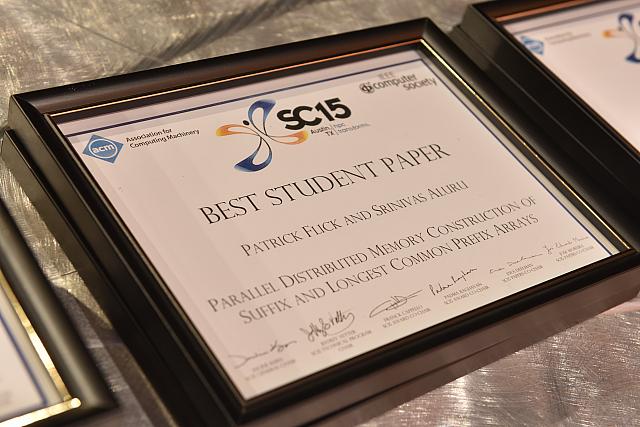
"Parallel Distributed Memory Construction of Suffix and Longest Common Prefix Arrays” by Patrick Flick and Srinivas Aluru was selected as the SC15 best student paper.

Patrick Flick’s and Srinivas Aluru’s winning paper proposes a novel algorithm for the suffix array problem. The performance results are very impressive and demonstrate a hundred fold improvement over existing methods. The algorithm itself has a potential broad impact on the field of genomics.

The three other finalists were:
  • Adaptive and Transparent Cache Bypassing for GPUs - with Ang Li from Eindhoven University of Technology as the lead author.
  • A Case for Application-Oblivious Energy - Efficient MPI Runtime- with Akshay Venkatesh - Ohio State University as the lead author.
  • GraphReduce: Processing Large-Scale Graphs on Accelerator - Based Systems - with Dipanjan Sengupta - Georgia Institute of Technology as the lead author

Best Overall Paper
 
The SC15 Best Paper, ”ScaAnalyzer — A Tool to Identify Memory Scalability Bottlenecks in Parallel Programs” by Xu Liu and Bo Wu.

Xu Liu’s and Bo Wu’s winning paper proposes methods and tools that isolate the causes of memory bottlenecks in both hardware and software in advanced computing systems. The committee felt the fundamental contributions address the memory wall problem and could have wide applicability in software development at Exascale.

The Best Paper authors (with certificates from left) Bo Wu and Xu Liu receive their awards from members of the SC15 Awards Committee who are (from left) Padma Raghavan, Eva Deelman and José Moreira, co-chairs of the SC15 Technical Papers Committee, and Franck Cappello.

The other finalists were:
  • Massively Parallel Phase-Field Simulations for Ternary Eutectic Directional Solidification - with Martin Bauer - FAU Erlangen Nuremberg as the lead author.
  • Efficient Implementation of Quantum Materials Simulations on Distributed CPU-GPU Systems - with Raffaele Solcà - ETH Zurich as the lead author.
  • Adaptive and Transparent Cache Bypassing for GPU's - with Ang Li - Eindhoven University of Technology as lead author.
  • Exploiting Asynchrony from Exact Forward Recovery for DUE in Iterative Solvers - with Luc Jaulmes - Barcelona Supercomputing Center as the lead author.
  • PGX.D: A Fast Distributed Graph Processing System - with Sungpack Hong - Oracle Corporation as the lead author. 

Check back here for additional coverage of other SC15 award winners in the near future.

Thursday, November 19, 2015

SC15 Breaks Exhibits and Attendance Records While in Austin, Texas

Noted science communicator and award-winning actor Alan Alda gives the SC15 Keynote Address in Austin, TX, where record-breaking attendance reached approximately  13,000 people.
 Media Contact: Brian Ban (773) 454-7423 or BrianBan@SC15Austin.com

Austin, TX - SC15, the 27th anniversary conference of high performance computing (HPC), networking, storage and analysis, celebrated the contributions of researchers and scientists - from those just starting their careers to those whose contributions have made lasting impacts.

The SC15 Exhibit Hall broke records in Austin, TX. (Click photo to enlarge.)
The conference drew a record-breaking 12,914+ registered attendees (as of data collected on 11/20) and featured a technical program spanning six days. The exhibit hall featured 343 exhibitors from industry, academia and research organizations from around the world.

Crowds rushed to the SC15 Exhibit Hall between engaging Technical Sessions.
“In a world of ever-growing, complex problems, high performance computing has a plethora of opportunities to impact lives across multiple fields,” said Jackie Kern, SC15 General Chair from the University of Illinois at Champaign-Urbana.

SC15 found its home in Austin, TX - pictured here at dawn.
She continued, “No longer is high performance computing reserved for only the biggest corporations in the world. It is now trickling down to smaller, medium-sized firms, which is only increasing its impact. This conference brings together the best research and industry minds in the world for one packed week of sharing ideas, networking, and education.”

SC15 General Chair Jackie Kern being interviewed by Austin-CBS affiliate KEYE in the Exhibit Hall.
According to Kern, the SC15 Exhibition was sold out and the industry-focused exhibit space was the largest to date in the history of the conference. The 217 industry-focused exhibits also marks a new SC15 record. In addition to record-breaking exhibit space, there were a total of 43 first-time exhibitors and 113 international exhibitors from 23 countries (outside the US).  In all, there was a total of approx. 137,000 net square feet of exhibit space and 343 industry and research organizations

SCinet - once again, the world's fastest conference computer network.
During the conference, Austin also became the hub for the world’s fastest conference computer network - SCinet (SC15’s custom network) which made 1.62 (16 100G + 2 10G) Terabits of bandwidth available to exhibitors and attendees.  The network featured 84 miles of fiber deployed throughout the convention center and $18 million in loaned equipment.  It was all made possible by 130 volunteers representing global organizations spanning academia, government and industry.

Noted science communicator and award-winning actor Alan Alda opened the SC15 Technical Program with a keynote speech focusing on the role of science in our society and the intersection of science and computing to a full house of approximately 3,000 people in Austin, Texas on November 17th.

Jeffrey S. Vetter, the SC15 Technical Program Chair, takes the stage.
The Technical Program again offered the highest quality in original HPC research. The SC workshops set a new record with more than 2,000 attendees. There were 10 Best Paper Finalists and 5 Gordon Bell Finalists. These submissions represent the best of the best in a wide variety of research topics in HPC.

Congrats to the 2015 Gordon Bell Prize Award winners. The team received their award at SC15 for using innovative algorithms & implicit solvers to realistically simulate current conditions of the Earth’s interior for the first time. Their work could herald a major step toward more accurately predicting earthquakes and volcanic eruptions.
Overall Stats on Tech Program Tracks:

•    75 Birds-of-a-Feathers
•    78 Papers
•    12 Panels
•    135 Posters  
•    41 Tutorials
•    42 Workshops
•    14 Invited Speakers
•    14 Doctoral Showcase Presentations
•    10 Emerging Technology Presentations

Intel executive Diane Bryant addresses the crowd at the HPC Matters Plenary.
For the second year, SC featured an opening “HPC Matters” plenary that this year was led by Diane Bryant, senior vice president and general manager of Intel’s Data Center Group, who discussed how next-generation supercomputers are transforming HPC.  She further identified exciting opportunities for advancing scientific research and discovery to deliver far-reaching impacts on society.

As part of this Plenary, Intel announced a $300,000 scholarship per-year for five years for women/minorities with STEM undergraduate degrees to fund fellowships for those pursuing PhD's degrees in computational and data science.  This commitment is in honor of Intel's third CEO Andrew Grove. 

The entire Plenary is available online and available by clicking here.

SC16 will be held next November 13th-18th in Salt Lake City, Utah.  For more details, click here.

About SC15
SC15, sponsored by ACM (Association for Computing Machinery) and IEEE Computer Society offers a complete technical education program and exhibition to showcase the many ways high performance computing, networking, storage and analysis lead to advances in scientific discovery, research, education and commerce. This premier international conference includes a globally attended technical program, workshops, tutorials, a world class exhibit area, demonstrations and opportunities for hands-on learning. For more information on SC15, please visit http://www.sc15.supercomputing.org/, or contact communications@info.supercomputing.org for more information.

About ACM
ACM, the Association for Computing Machinery www.acm.org, is the world’s largest educational and scientific computing society, uniting computing educators, researchers and professionals to inspire dialogue, share resources and address the field’s challenges. ACM strengthens the computing profession’s collective voice through strong leadership, promotion of the highest standards, and recognition of technical excellence. ACM supports the professional growth of its members by providing opportunities for life-long learning, career development, and professional.

Wednesday, November 18, 2015

Hear from NSF's Aaron Dubrow as He Lists 10 Ways Advanced Computing Catalyzes Science


Visualization of 3-D Cerebellar Cortex model generated by researchers Angus Silver and Padraig Gleeson from University College London. The NeuroScience Gateway was used for simulations. Credit: Angus Silver and Padraig Gleeson, University College London
When researchers need to compare complex new genomes; or map new regions of the Arctic in high-resolution detail; or detect signs of dark matter; or make sense of massive amounts of fMRI data, they turn to the high-performance computing and data analysis systems supported by the National Science Foundation (NSF).

High-performance computing (HPC) enables discoveries in practically every field of science - not just those typically associated with supercomputers like chemistry and physics - but also in the social sciences, life sciences and humanities.

By combining superfast and secure networks, cutting-edge parallel computing and analytics software, and advanced scientific instruments and critical datasets across the U.S., NSF's cyber-ecosystem lets researchers investigate questions that can't otherwise be explored.

NSF has supported advanced computing since its beginning and is constantly expanding access to these resources to help tens of thousands of researchers each year - from high school students to Nobel Prize winners -- at institutions large and small, regardless of geographic locality, expand the frontiers of science and engineering.

Click here for 10 examples of research -- enabled by advanced computing resources -- from across all of science.

Excerpted with permission from Aaron Dubrow, the National Science Foundation

Tuesday, November 17, 2015

Alan Alda Gives Inspiring Keynote to Open SC15 in Austin Today

Alan Alda gives the 2015 SC Keynote to more than 3,000 attendees on Nov. 17th in Austin. 
Noted science communicator and award-winning actor Alan Alda opened SC15 with keynote speech focusing on the role of science in our society and the intersection of science and computing to a full house of more than 3,000 people in Austin, Texas on Nov. 17.

SC15 Chair Jackie Kern
“High performance computing has a transformational impact on science in our society,” comments SC15 general chair Jackie Kern, University of Illinois at Urbana Champaign. “For decades scientists and engineers have relied on high performance computing to advance the state of the art in diverse fields ranging from healthcare and automotive safety to renewable energy. Computing is now fully integrated into the scientific discovery process, an equal partner with theory and experiment in improving the quality of life for all members of our global society.

She continues, "Mr. Alda’s focus on communicating the benefits of science to the public—and how we can all do this more effectively—makes him uniquely positioned to help SC continue to bridge the gaps in science understanding and highlight our role in the discovery process.”

To view the write up in the Austin Business Journal, click here.

Mr. Alda--actor, writer, science advocate, and Visiting Professor at Stony Brook University—shared his passion for science communication and its importance, drawing on his personal experiences including his 11 years as host of the TV series Scientific American Frontiers.

Throughout his 40-year career, he has won seven Emmys, six Golden Globes, and three Directors Guild of America awards for directing. Alda also hosted the 2010 PBS mini-series The Human Spark and wrote Radiance: The Passion of Marie Curie, a play about the personal life of the great scientist who discovered radium. He teamed up with PBS again in 2013 for Brains on Trial, a neurological look at brains in the court room.

A recipient of the National Science Board’s Public Service Award, Alda is a visiting professor at and founding member of Stony Brook University’s Alan Alda Center for Communicating Science, where he helps develop innovative programs on how scientists communicate with the public. He is also on the Board of Directors of the World Science Festival.

Monday, November 16, 2015

SC15 HPC Matters Plenary Session Available Now Online

SC15 just released the full HPC Matters Plenary on YouTube for all to access.  Watch as Jackie Kern, SC15 General Chair from the University of Illinois, introduces Diane Bryant who then discusses how next-generation supercomputers are transforming HPC and presents exciting opportunities to advance scientific research and discovery to deliver far-reaching impacts on society.


As part of this Plenary, Intel announced a $300,000 scholarship per year for five years for women/minorities with STEM undergraduate degrees to fund fellowships for those pursuing PhD's degrees in computational and data science.  This commitment is in honor of Intel's third CEO Andrew Grove.

 Making special appearances were Intel Fellows Mark Bohr, Matt Adiletta, Al Gara, Mark Seager, Bill Magro, and Pradeep Dubey.

Closing out the HPC Matters Plenary was Wilf Pinfold, HPC Matters Chair from Concurrent Systems. Wilf encouraged future engagement by the audience in the HPC Matters theme for the coming year.  To learn more about the HPC Matters Program, click here or to view the HPC Matters short, compelling videos, click here.

Sunday, November 15, 2015

Connecting Live in Austin with One of the Mosts Powerful Networks in the World

The SCinet network, SC’s Supercomputing Internet, is now live! On November 14, the Austin Convention Center became home to the fastest and most innovative computer network in the world built by volunteers, delivering more than 1.6 terabits per second of network bandwidth to the SC conference (SC15).

SCinet gives the SC conference attendees a unique chance to showcase and discover the latest research in HPC. By building the fastest, most innovative operational network possible every year, SCinet enables data-intensive research and live-use of high performing hardware to run multi-gigabit demonstrations, requiring a fast and robust infrastructure.

SC15 SCinet Contributors (click to enlarge).
“This network is unrivaled with regards to its capabilities and the broad-reaching influence, both nationally and internationally, to support demonstrations and experiments that could not be done easily in any other place. It’s a one-of-a-kind environment where research meets production,” says Davey Wheeler, SCinet Chair and Senior Network Engineer from the National Center for Supercomputing Applications (NCSA) at the University of Illinois at Urbana-Champaign (UIUC). “As the SCinet Chair leading the development of this network, this year is a culmination of 17 years of experience working on SCinet from year to year. It is humbling and honoring to be able to work aside these colleagues and see the tremendous talent, dedication, and creativity of the volunteers.”

SCinet is built by a team of expert volunteers from around the world, taking one year to design the network, three weeks to set it up, four days to operate it, and twenty-four hours to tear it down. Over 100 engineers from industry, academia and government institutions came together to build this network, using over $22 million in loaned equipment and over 89 miles of newly installed fiber optic cables.

“Having been the SCinet Chair for SC07 in Reno, I am intimately familiar with the incredible amount of planning and work that goes into creating what will be the most powerful network. Over 130 SCinet volunteers from more than 15 countries have worked energetically for the past year to provide wired and wireless access to our conference attendees, and the platform for our exhibitors to showcase bandwidth-driven HPC and cloud computing applications. SCinet continues to be a crucial part of SC and I am extremely grateful for their hard work,” says Jackie Kern, Director of IT Shared Services at UIUC and SC15 Conference Chair.

For SC15, SCinet has connected multiple 100 gigabit circuits, bringing an unprecedented 1.62 terabits per second of bandwidth to the Austin Convention Center. Lonestar Education and Research Network (LEARN) leads this effort in collaboration with leading national and international research networks and commodity providers. LEARN and SCinet supports the HPC community by providing multiple 100 gigabit waves and complementary capabilities throughout the SC15 conference events. 

In addition to the massive external capacity SCinet brings to the convention center, the network is also supporting research initiatives through a half-day workshop, Innovating the Network for Data-Intensive Science (INDIS); and the Network Research Exhibition (NRE). SCinet organizes the INDIS workshop to discuss technical papers and show floor demonstrations dedicated to high performance networking technologies, innovations, protocols, hardware, and much more.

Further, SCinet is providing the wireless connectivity for more than 11,000 expected conference attendees throughout the conference areas. The SCinet team built the SC15 wireless network using 339 wireless access points to support more than 4,000 simultaneous users on the conference wifi. The wireless network will include support for eduroam (education roaming) service, which allows users (researchers, teachers, students, and staff) from participating institutions to securely access the protected wireless network using their home organization’s login credentials.

SCinet is the result of the hard work and significant contributions of many government, research, education and corporate collaborators who have volunteered time, equipment and expertise to ensure SC15’s success. This year, SCinet continued the Contributors Program and we would like to give a special thank you to all SCinet contributors and volunteers!

Platinum contributors: CenturyLink, Ciena, ESnet, Infinera, Internet2, Juniper Networks, and Lonestar Education and Research Network (LEARN).

Gold contributors: Brocade, Cisco, and Gigamon.

Silver contributors: Alcatel-Lucent, Arista, Austin Convention Center, Dell, Greater Austin Area Telecommunications Network (GAATN), inMon, IXIA, Reservoir Labs, Spirent, and The University of Texas System.

Bronze contributors: CABLExpress, Commscope, Splunk, Verisign, and Viavi Solutions.

Volunteers from the following organizations supporting the development and deployment of SCinet: Alcatel-Lucent, Army Research Laboratory, CABLExpress Corporation, CENIC, CenturyLink, Ciena, Cisco, Clemson University, DFN-Verein, DataDirect Networks, Dell Research, Energy Sciences Network (ESnet), Florida LambdaRail (FLR), Freelance, Georgia Institute of Technology, Idaho State University, InMon Corporation, Indiana University, Indiana University GlobalNOC, Indiana University of Pennsylvania, Infinera, Internet Consulting of Vermont, Internet2, JDSU, Lawrence Livermore National Laboratory, Lonestar Education and Research Network (LEARN), Louisiana Optical Network Initiative (LONI), Louisiana State University, the National Center for Supercomputing Applications, National Oceanic and Atmospheric Administration (NOAA), Pennsylvania State University, Purdue University, REANNZ, Radware, Reservoir Labs, SURFnet, Sandia National Laboratories, The University of Texas at Austin, University Corporation for Atmospheric Research, University of Amsterdam, University of California, San Diego, University of Colorado Boulder, University of Heidelberg, University of Illinois at Urbana-Champaign, University of Michigan, University of Oklahoma, University of Pittsburgh, University of Tennessee, Knoxville, University of Texas, University of Wisconsin-Madison, Utah Education Network, and Virginia Polytechnic Institute and State University.

If you’re interested in volunteering for SCinet or participating in the Contributor’s Program for SC16, please email scinet@info.supercomputing.org.

HPCwire Interviews Diane Bryant On Eve of HPC Matters Plenary

HPC Matters Plenary Speaker Diane Bryant
Thomas Ayres and Tiffany Trader for HPCwire

Back in September, the news broke that Intel’s Senior Vice President Diane Bryant was named the HPC Matters plenary speaker for the SC15 conference taking place in Austin, Texas.

The theme for this year’s HPC Matters program is “Fueling the Transformation” and Bryant, along with multiple industry luminaries, will be taking the stage before the SC15 opening gala on November 16 to discuss the myriad of ways that HPC is transforming lives.

Bryant leads Intel’s datacenter business unit, one of the chipmaker’s strongest segments. This year, FORTUNE magazine named Bryant to its Most Powerful Women in Business list. Criteria for selection to this prominent listing includes the importance of the woman’s business in the global economy, health and direction of the business, career arc, and cultural influence.

This dovetails well with Bryant’s role as speaker for this year’s HPC Matters plenary. The HPC Matters program, launched by the SC program committee two years ago, rests on four pillars: influencing daily lives, science and engineering, economic impact, and education.

Bryant speaks frequently on all of these issues and has been especially prominent in promoting the benefits of diversity in the workplace. For the upcoming HPC Matters plenary, Bryant will draw on her experience running Intel’s datacenter group, which includes the HPC business segment and products ranging from high-end coprocessors for supercomputers, to big data analytics solutions, to high-density systems for the cloud. In the exclusive interview to follow, she shares her thoughts on where she sees HPC heading in the upcoming years, why it’s an important topic in our world, and how her career at Intel has shaped her views on HPC. Following is the interview:

HPCwire: What key points are you going to touch on in your presentation?
Diane Bryant: We are in the midst of an unprecedented change in High Performance Computing. Everything about how HPC systems are used and built is going to change over the next decade. HPC must support more complex models with more and more data, and enable new usages as industries realize the benefits of very powerful real-time analytics.  To meet these needs, HPC must achieve exascale performance and beyond, while expanding access to more users.  This will require a transformation of not only the systems, but the entire solution stack.

How does HPC matter to you?
Diane Bryant: As an engineer, what excites me is seeing how information technology is used to solve real world problems.  HPC is a transformational capability helping solve society’s most pressing challenges.  Look at the improvements in life science and precision medicine that have really been enabled by researchers and physicians gaining access to more powerful supercomputers.  Seeing industry after industry take these tools with Intel technology as their foundation and use them to improve lives and drive economic growth is tremendously gratifying and exciting to all of us who work to push IT forward.

Click here to go to the full HPCwire article.

Thursday, October 29, 2015

SC15 Invited Talk Focus: Dr. Panagiotis Tsarchopoulos Explains the European Supercomputing Research Programme


Over the last couple of years, through a number of policy and research initiatives, the European Union has worked in putting together an ambitious supercomputing research programme.

As part of this effort, in autumn 2015, the European Commission has launched several new supercomputing projects covering supercomputing hardware, software and applications. This launch marks an important milestone in European supercomputing research and development.

The talk will provide a detailed overview of the European supercomputing research programme, its current status, and its future perspectives towards exascale.

Speaker Background:
Dr. Panagiotis (Panos) Tsarchopoulos
Dr. Panagiotis (Panos) Tsarchopoulos is responsible for supercomputing research projects at the Future and Emerging Technologies unit of the European Commission. He holds a Ph.D. in computer engineering from the University of Kaiserslautern, Germany and an M.B.A. from the UBI, Brussels, Belgium.

Sunday, October 25, 2015

SC15 Invited Talk Spotlight: Dr. Yutaka Ishikawa Presents System Software in Post K Supercomputer

The K computer manufactured by Fujitsu, currently installed at the RIKEN Advanced Institute for Computational Science campus in Kobe, Japan.

The next flagship supercomputer in Japan, replacement of K supercomputer, is being designed toward general operation in 2020. Compute nodes, based on a many core architecture, connected by a 6-D mesh/torus network is considered. A three level hierarchical storage system is taken into account.


Co-kernel approach for HPC OS: Separation of system and process activities.

A heterogeneous operating system, Linux and a light-weight kernel, is designed to build suitable environments for applications. It cannot be possible without co-design of applications that the system software is designed to make maximum utilization of compute and storage resources.

After a brief introduction of the post K supercomputer architecture, the design issues of the system software will be presented in this Talk. Two big-data applications, genome processing and meteorological and global environmental predictions will be sketched out as target applications in the system software design. Then, it will be presented how these applications' demands affect the system software.

Dr. Yutaka Ishikawa
Speaker Background:    
Dr. Yutaka Ishikawa is the project leader of post K supercomputer development. From 1987 to 2001, he was a member of AIST (former Electrotechnical Laboratory), METI. From 1993 to 2001, he was the chief of Parallel and Distributed System Software Laboratory at Real World Computing Partnership.

He led development of cluster system software called SCore, which was used in several large PC cluster systems around 2004.

From 2002 to 2014, he was a professor at the University Tokyo. He led the project to design a commodity-based supercomputer called T2K open supercomputer.

As a result, three universities (Tsukuba, Tokyo, and Kyoto), obtained each supercomputer based on the specification in 2008. He has been involved in the design of the post T2K machine since 2013, which will be operational in 2020.   

Thursday, October 22, 2015

Mentor-Protégé Program Needs You

Mentor Jim Ahrens of Los Alamos National Laboratory meets with his protégé, Maria Ruiz, at SC14.
Organized as part of the Students@SC program, the Mentor-Protégé Program supports the growth of a vibrant HPC community by connecting the newcomers at the SC conference with experienced conference attendees.

The mentors share their experiences from previous SC conferences and their expertise in high performance computing with the student protégés participating in Student Volunteers, HPC for Undergraduates, the Student Cluster Competition, the Doctoral Showcase and the ACM Student Research Competition.

For many of the students, SC will be their first conference and can be an overwhelming experience. A mentor can help them make the best use of their time and make personal connections with the HPC community.

Want to be a mentor?

Conference attendees who have attended SC one or more times in the past are encouraged to sign up to be mentors when they register for SC. Mentors will also choose their discipline on the form to help make the best matches. Mentors should plan their travel arrangements so they can attend a Monday afternoon mixer for mentors and protégés from 3:30-5 pm. Monday, Nov. 16.

Click here for more details on the program including Jim Ahrens's and Maria Ruiz's experience from SC14.

Wednesday, October 21, 2015

SC15 Panel Line-Up for Nov. 19th

Asynchronous Many-­Task Programming Models for Next Generation Platforms

Next generation platform architectures will require us to fundamentally rethink our programming models and environments due to a combination of factors including extreme parallelism, data locality issues, and resilience. As seen in the computational sciences community, asynchronous many-task (AMT) programming models and runtime systems are emerging as a leading new paradigm.

While there are some overarching similarities between existing AMT systems, the community lacks consistent 1) terminology to describe runtime components, 2) application- and component-level interfaces, and 3) requirements for the lower level runtime and system software stacks.

This panel will engage a group of community experts in a lively discussion on status and ideas to establish best practices in light of requirements such as performance portability, scalability, resilience, and interoperability. Additionally, we will consider the challenges of user-adoption, with a focus on the issue of productivity, which is critical given the application code rewrite required to adopt this approach.

Moderator/Panelist Details:
  • Robert Clay (Moderator) - Sandia National Laboratories
  • Alex Aiken - Stanford University
  • Martin Berzins - University of Utah
  • Matthew Bettencourt - Sandia National Laboratories
  • Laxmikant Kale - University of Illinois at Urbana-Champaign
  • Timothy Mattson - Intel Corporation
  • Lawrence Rauchwerger - Texas A&M University
  • Vivek Sarkar - Rice University
  • Thomas Sterling - Indiana University
  • Jeremiah Wilke - Sandia National Laboratories


Towards an Open Software Stack for Exascale Computing

The panel will discuss what an open software stack should contain, what would make it feasible and what is not looking possible at the moment. The discussion is inspired by the fact that "this time, we have time" before the hardware actually reaches the market after 2020, so we can work on a software stack accordingly.

We will cover questions such as: Which would be the software development costs? What industries will migrate first? Would a killer app accelerate this process? Do we focus on algorithms to save power? How heterogeneous would/should “your” exascale system be? Is there a role for Co-design towards exascale? Is the Square Kilometre Array (SKA) project an example to follow? Would cloud computing be possible for exascale? Who will “own” the exascale era?

Moderator/Panelist Details:
  • Nicolás Erdödy (Moderator) - Open Parallel Ltd.
  • Pete Beckman - Argonne National Laboratory
  • Chris Broekema - Netherlands Institute for Radio Astronomy
  • Jack Dongarra - University of Tennessee
  • John Gustafson - Ceranovo, Inc.
  • Thomas Sterling - Indiana University
  • Robert Wisniewski - Intel Corporation


Procuring Supercomputers: Best Practices and Lessons Learned

Procuring HPC systems is a challenging process of acquiring the most suitable machine under technical and financial constrains aiming at maximizing the benefits to the users’ applications and minimizing the risks during its lifetime.

In this panel, HPC leaders will discuss and debate on keys requirements and lessons learned for successful procurements of supercomputers.

How do we define the requirements of the system? Is it to acquire a system for maximizing the capacity and capability, assessing new/future technologies, deliver a system designed for specific applications or provide an all-purpose solution to a broad range of applications? Is the system just a status symbol or must it do useful work?

This panel will give the audience an opportunity to ask questions to panelists who are involved in the procurement of leadership-class supercomputers and capturing lessons learned and turning that hindsight into best practices to procure and the most suitable HPC system.

Moderator/Panelist Details:
  • Bilel Hadri (Moderator) - King Abdullah University of Science and Technology
  • Katie Antypas - National Energy Research Scientific Computing Center
  • Bill Kramer - University of Illinois at Urbana-Champaign
  • Satoshi Matsuoka - Tokyo Institute of Technology
  • Greg Newby - Compute Canada
  • Owen Thomas - Red Oak Consulting

Friday, October 16, 2015

SC15 Releases Short Video Explaining Why High Performance Computing is Important to NASA

NASA Aerospace Engineer Dr. Shishir Pandya explains how high performance computers (HPCs) help advance airplane and rocket technologies to save fuel and make travel more affordable for the public.  According to Pandya it is also critical to be pushing technology further to search for that next breakthrough.


This is another chapter in a series of short videos focusing on why HPC is important and of critical value to society. It is part of a three-year SC "HPC Matters" campaign.  Click here to view the entire HPC Matters video library. Also, once again, there will be an HPC Matters Plenary during the conference.  This year's chosen speaker is Intel's Diane Bryant - recently named one of the top 51 most powerful women by Forbes. To view those details, click here.

Editorial note: Special thanks to NASA's Jill Dunbar for her assistance on this project.

Wednesday, October 14, 2015

SC15 Invited Talk Spotlight: The U.S. National Strategic Computing Initiative as Explained by the White House's Randal Bryant and Tim Polk

Tim Polk and Randal Bryant will explain the current status of the National Strategic Computing Initiative and provide a look into its future impact as it relates to high performance computing.
U.S. President Obama signed an Executive Order creating the National Strategic Computing Initiative (NSCI) on July 31, 2015.

In the order, he directed agencies to establish and execute a coordinated Federal strategy in high-performance computing (HPC) research, development, and deployment. The NSCI is a whole-of-government effort to be executed in collaboration with industry and academia, to maximize the benefits of HPC for the United States.

The Federal Government is moving forward aggressively to realize that vision. This presentation will describe the NSCI, its current status, and some of its implications for HPC in the U.S. for the coming decade.

Click here to review the official Executive Order from President Obama and click here for the official fact sheet.

Speaker Backgrounds:

Randal E. Bryant
Executive Office of the President, Office of Science and Technology Policy
The United States of America
Randal Bryant has been on the computer science faculty at Carnegie Mellon University for over 30 years, serving as Dean of the School of Computer Science from 2004 to 2014. Starting in 2014, he also has been at the White House Office of Science and Technology Policy, where he serves as Assistant Director for IT R&D.

William (Tim) Polk    
Executive Office of the President, Office of Science and Technology Policy
The United States of America 
Tim Polk joined the National Institute of Standards and Technology in 1982, where he has concentrated on Internet security since 1987. In 2013, he joined the Office of Science and Technology Policy, where high performance computing complements his duties as Assistant Director for Cybersecurity.

Register for SC15 by Oct. 15th and Save up to $275!

SC15 is the 27th year of the SC Conference series – once again featuring an exceptional Technical Program, Industry and Research Exhibits, Education Program and many other activities.  SC15 is the one place where attendees can see tomorrow’s technology being used to solve world-class challenge problems today.

The SC15 early registration deadline is October 15th.  The fee structure for SC15 makes it even more advantageous to register early this year. Registering early can save you up to $275 off your Technical Program registration (depending on your registration category).  Also, registering by Oct. 15th can save you up to $350 off Tutorial registration. Register early for both and save up to $625!

Conference attendees, click here to register.

Exhibitor Booth Management, click here to register.

Wednesday, October 7, 2015

SC15 Panel Focus for Nov. 17th

Panel Title: Post Moore's Law Computing: Digital versus Neuromorphic versus Quantum

The end of Moore’s Law scaling has sparked research into preserving performance scaling through alternative computational models. This has sparked a debate for the future of computing. Currently, the future of computing is expected to include a mix of quantum, neuromorphic, and digital computing. However, a range of questions remain unanswered for each option.

For example, what problems each approach is most efficient for remains to be determined, and so are issues such as manufacturability, long-term potential, inherent drawbacks, programming, and many others. Can neuromorphic or quantum ever replace digital computing? Can we find alternative CMOS technologies and clever architectures to preserve digital computing performance scaling? What is the upper limit of CMOS?

This is a critical debate for a wide audience, because solving many of tomorrow’s problems requires a reasonable expectation of what tomorrow looks like.

Moderator/Panelist Details:
  • George Michelogiannakis (Moderator) - Lawrence Berkeley National Laboratory
  • John Shalf - Lawrence Berkeley National Laboratory
  • Bob Lucas - University of Southern California
  • Jun Sawada - IBM Corporation
  • Mattias Troyer - ETH Zurich
  • David Donofrio - Lawrence Berkeley National Laboratory
  • Shekhar Bokhar - Intel Corporation

Panel Title: Future of Memory Technology for Exascale and Beyond III

Memory technology is in the midst of profound change as we move into the exascale era. Early analysis, including the DARPA UHPC Exascale Report correctly identified the fundamental technology problem as one of enabling low-energy data movement throughout the system.

However, the end of Dennard Scaling and the corresponding impact on Moore’s Law has begun a fundamental transition in the relationship between the processor and memory system. The lag in the increase in the number of cores compared to what Moore’s Law would provide has proven a harbinger of the trend towards memory systems performance dominating compute capability.

Moderator/Panelist Details:
  • Richard Murphy (Moderator) - Micron Technology, Inc.
  • Shekhar Borkar - Intel Corporation
  • Bill Dally - NVIDIA Corporation
  • Wendy Elasser - ARM Ltd.
  • Mike Ignatowski - Advanced Micro Devices, Inc.
  • Doug Joseph - IBM Corporation
  • Peter Kogge - University of Notre Dame
  • Steve Wallach - Micron Technology, Inc.

Wednesday, September 30, 2015

SC15 Invited Talk Spotlight: The Power of Visual Analytics - Unlocking the Value of Big Data

Visual Exploration of Network Traffic for Host and Server Monitoring: The screenshot shows the hourly amount of network traffic for thousands of hosts in a large computer network for 24 hours. The different nested circles represent the topological subnet hierarchy of the network. Each filled circle represents a whole subnet or when zoomed in single hosts. Each circle consists of 24 segments, while each colored segment visualizes the number of bytes transferred in the respective hour.
Never before has data been generated and collected at such high volumes as it is today. As the volumes of multidimensional data available to businesses, scientists, and the public increase, their effective use becomes more challenging. Visual analytics seeks to provide people with effective ways to understand and analyze large multidimensional data sets, while also enabling them to act upon their findings immediately.

Visualization of Large-Scale Distributed Network Attacks:  This picture illustrates attacks from the Internet to computers located in a large computer network (brute force SSH attacks).  The background represents the network structure with computer systems as rectangles. External hosts are shown as colored circles on the outside.  The splines represent the connections between attackers and computers within the network.  This reveals a network scan (from top) and a distributed attack (from bottom) originating from hundreds of hosts working together in an attempt to break into specific computer systems.
It integrates the analytic capabilities of the computer and the abilities of the human analyst, allowing novel discoveries and empowering individuals to take control of the analytical process.

This talk presents the potential of visual analytics and discusses the role of automated versus interactive visual techniques in dealing with big data. A variety of application examples ranging from news analysis over network security to SC performance analysis illustrate not only the exiting potential of visual analysis techniques, but also their limitations.

Speaker background:       
Dr. Daniel A. Keim
Dr. Daniel A. Keim is professor and head of the Information Visualization and Data Analysis Research Group in the Computer Science Department of the University of Konstanz, Germany. He has been actively involved in data analysis and information visualization research for more than 20 years and developed a number of novel visual analysis techniques for very large data sets.

He has been program co-chair of the IEEE InfoVis and IEEE VAST as well as the ACM SIGKDD conference, and he is member of the IEEE VAST as well as EuroVis steering committees. He is coordinator of the German Science Foundation funded Strategic Research Initiative "Scalable Visual Analytics" and has been scientific coordinator of the European Commission funded Coordination Action "Visual Analytics - Mastering the Information Age (VisMaster)".

Dr. Keim received his Ph.D. and habilitation degrees in computer science from the University of Munich. Before joining the University of Konstanz, Dr. Keim was associate professor at the University of Halle, Germany, and Senior Technology Consultant at AT&T Shannon Research Labs, NJ, USA.

Tuesday, September 22, 2015

Invited Talk Spotlight: Supercomputing, High-Dimensional Snapshots, and Low-Dimensional Models - A Game Changing Computational Technology for Design and Virtual Testing

Aerodynamic analysis of a complete Formula 1 configuration (click on any image to enlarge it).
During the last two decades, giant strides have been achieved in many aspects of computational engineering. Higher-fidelity mathematical models and faster numerical algorithms have been developed for an ever increasing number of applications. Linux clusters are now ubiquitous, GPUs continue to shatter computing speed barriers, and Exascale machines will increase computational power by at least two orders of magnitude.

Coupled fluid-structure analysis of an F-16 Fighting Falcon configuration at high angle of attack.
More importantly, the potential of high-fidelity physics-based simulations for providing deeper understanding of complex systems and enhancing their performance has been recognized in almost every field of engineering. Yet, in many applications, high-fidelity numerical simulations remain so computationally intensive that they cannot be performed as often as needed, or are more often performed in special circumstances than routinely.

High-dimensional solution snapshots of a street car flow problem computed for the purpose of constructing a parametric reduced-order model.
Consequently, the impact of supercomputing on time-critical operations such as engineering design, optimization, control, and test support has not yet fully materialized. To this effect, this talk will argue for the pressing need for a game-changing computational technology that leverages the power of supercomputing with the ability of low-dimensional computational models to perform in real-time.

It will also present a candidate approach for such a technology that is based on projection-based nonlinear model reduction, and demonstrate its potential for parametric engineering problems using real-life examples from the naval, automotive, and aeronautics industries.

Speaker Background:
Invited speaker Charbel Farhat prior to his flight in a F/A-18 Hornet with the legendary Blue Angels.
Charbel Farhat is the Vivian Church Hoff Professor of Aircraft Structures, Chairman of the Department of Aeronautics and Astronautics, and Director of the Army High Performance Computing Research Center at Stanford University. He is a member of the National Academy of engineering, a Fellow of AIAA, ASME, IACM, SIAM, and USACM, and a designated Highly Cited Author in Engineering by the ISI Web of Knowledge.

He was knighted by the Prime Minister of France in the Order of Academic Palms and awarded the Medal of Chevalier dans l’Ordre des Palmes Academiques. He is also the recipient of many other professional and academic distinctions including the Lifetime Achievement Award from ASME, the Structures, Structural Dynamics and Materials Award from AIAA, the John von Neumann Medal from USACM, the Gauss-Newton Medal from IACM, the Gordon Bell Prize and Sidney Fernbach Award from IEEE, and the Modeling and Simulation Award from DoD.

Recently, he was selected by the US Navy as a Primary Key-Influencer, flown by the Blue Angels during Fleet Week 2014, and appointed to the Air Force Science Advisory Board.


Monday, September 21, 2015

SC15 Releases Video on How Berkeley Lab's Electrolyte Genome Project Could Be Battery Game-Changer

A new breakthrough battery—one that has significantly higher energy, lasts longer, and is cheaper and safer—will likely be impossible without a new material discovery. And a new material discovery could take years, if not decades, since trial and error has been the best available approach. But Lawrence Berkeley National Laboratory (Berkeley Lab) scientist Kristin Persson says she can take some of the guesswork out of the discovery process with her Electrolyte Genome.

Think of it as a Google-like database of molecules. A battery scientist looking for a new electrolyte would specify the desired parameters and properties, and the Electrolyte Genome would return a short list of promising candidate molecules, dramatically speeding up the discovery timeline.
Click here to watch the video.


“This is just one of several compelling videos that SC15 will be releasing over the coming weeks to help describe how high performance computing is helping to transform society and have a tremendous positive impact on everyday life,” said Jackie Kern, SC15 Conference Chair from University of Illinois at Urbana Champaign.

According to Kern, It is also part of a three-year “HPC Matters” campaign that will be a big focus at the SC15 conference in Austin this November.  This includes a free plenary session led by Diane Bryant – one of Intel’s top executives and recently named to Fortune’s list of the 51 most powerful women.

Faster, Smarter, Better
Besides being faster and more efficient in screening out bad candidates, the Electrolyte Genome offers two other significant advantages to battery scientists. The first is that it could generate novel ideas. “While there are some amazing organic chemists out there, this allows us to be agnostic in how we search for novel ideas instead of relying purely on chemical intuition,” Persson said. “We can be surprised by what we find by combining experience with new, non-traditional ideas.”

The second advantage of the Electrolyte Genome is that it can add to scientists’ fundamental understanding of chemical interactions.

“It adds explanations to why certain things work or don’t work,” Persson said. “Frequently we rely on trial and error. If something doesn’t work, we throw it away and go to the next thing, but we don’t understand why it didn’t work. Having an explanation becomes very useful—we can apply the principles we’ve learned to future guesses. So the process becomes knowledge-driven rather than trial and error.”

How it Works – Funnel Method
The Electrolyte Genome uses the infrastructure of the Materials Project, a database of calculated properties of thousands of known materials, co-founded by Persson and Gerbrand Ceder. The researchers apply a funnel idea, doing a first screening of materials by applying a series of first principles calculations for properties that can be calculated quickly and robustly. This winnows down the candidate pool, on which they do a second screening for another property, and so on.

The concept was described in a recent essay in The Journal of Physical Chemistry Letters co-authored by Persson and her collaborators at Berkeley Lab and Argonne National Laboratory.
With a short list of candidate molecules, researchers can then perform more detailed computational evaluations, applying molecular dynamics simulations or other calculations as needed, for example to characterize the interactions of the different components.

The number of possible combinations is infinite since so many different salts can be combined with so many different solvents; plus impurities play a role. So Persson and her team do work closely with experimentalists to guide their research. “Because the space is so vast, we typically don’t throw the whole kitchen sink at it because it would take forever,” she said. “We tend to take some base molecule or some idea, then we explore all the variations on that idea. That’s the way to attack it.”

The methodology has been validated with known electrolytes. Using the supercomputers at the Department of Energy’s National Energy Research Scientific Computing Center (NERSC) at Berkeley Lab, the researchers can screen hundreds of molecules per day.

To date, more than 15,000 molecules for electrolytes—including 10,000 redox active molecules, hundreds of conductive network molecules, and salts, solvents, and more—have been calculated. Screening such quantities of molecules for suitable properties using traditional synthesis and testing techniques would take decades.
Early Success Stories

The Electrolyte Genome’s first major scientific finding—that magnesium electrolytes are very prone to forming ion pairs, which impacts several crucial aspects such as conductivity, charge transfer and stability of the electrolyte—was published in February in the Journal of the American Chemical Society.

They had another success screening molecules for redox capabilities for flow batteries for fellow Berkeley Lab scientist Brett Helms. “He basically gave us a chemical space of organogelator molecules and asked, ‘Can you tell me the best molecule if I want a voltage window that’s precisely here,’” Persson said. “We filtered down about a hundred candidates to one. It worked, and the molecule fit the intended purpose perfectly.”

The Electrolyte Genome is funded by the Joint Center for Energy Storage Research (JCESR), a Department of Energy multi-partner Energy Innovation Hub announced in 2012, led by Argonne National Laboratory and including Berkeley Lab. It is open source and will be made public by the end of JCESR’s five-year charter, at the latest, according to Persson.
This is the first in a series of SC15 videos that will be released leading up to the conference to help tell compelling and interesting stories of why HPC Matters.
 
About SC15
SC15, sponsored by ACM (Association for Computing Machinery) and IEEE Computer Society offers a complete technical education program and exhibition to showcase the many ways high performance computing, networking, storage and analysis lead to advances in scientific discovery, research, education and commerce. This premier international conference includes a globally attended technical program, workshops, tutorials, a world class exhibit area, demonstrations and opportunities for hands-on learning. For more information on SC15, please visit http://www.sc15.supercomputing.org/, or contact communications@info.supercomputing.org for more information.
 
About ACM
ACM, the Association for Computing Machinery www.acm.org, is the world’s largest educational and scientific computing society, uniting computing educators, researchers and professionals to inspire dialogue, share resources and address the field’s challenges. ACM strengthens the computing profession’s collective voice through strong leadership, promotion of the highest standards, and recognition of technical excellence. ACM supports the professional growth of its members by providing opportunities for life-long learning, career development, and professional networking.

Special thanks to Julie Chao from Lawrence Berkeley National Laboratory for her assistance with this article and video.

Thursday, September 10, 2015

SC15 Announces Intel’s Diane Bryant as HPC Matters Plenary Speaker

Intel's Diane Bryant
Austin, TX (USA) – September 10, 2015 – SC15 today announced that Intel’s Diane Bryant, senior vice president and general manager of Intel’s Data Center Group, has been selected as the HPC Matters plenary speaker at the 27th annual SC15 conference on high performance computing (HPC), networking, storage and analysis.

Starting in 2013, the SC conference organizers launched “HPC Matters” to encourage members of the computational sciences community to share their thoughts, vision, and experiences with how high performance computers are used to improve the lives of people all over the world in more simple terms. Four pillars provide structure to the program: Influencing Daily Lives; Science and Engineering; Economic Impact; and Education

Bryant will discuss how next-generation supercomputers are transforming HPC and presenting exciting opportunities to advance scientific research and discovery to deliver far-reaching impacts on society.

“In a real sense, transformation is at the heart of existence, and ultimately the challenge and opportunity before us is to perceive and comprehend the power of transformation so that we can use it for the good of the world and everything in it. Nothing does that better than high performance computing,” observes SC15 general chair Jackie Kern, University of Illinois at Urbana Champaign.

As a frequent speaker on the future of technology, Bryant will draw on her experience running Intel’s Data Center Group, which includes the HPC business segment, and products ranging from high-end co-processors for supercomputers to big data analytics solutions to high-density systems for the cloud. The SC15 HPC Matters plenary takes place on Monday, November 16th, at 5:30 p.m. at the Austin Convention Center.

About SC15
SC15, sponsored by ACM (Association for Computing Machinery) and IEEE Computer Society offers a complete technical education program and exhibition to showcase the many ways high performance computing, networking, storage and analysis lead to advances in scientific discovery, research, education and commerce. This premier international conference includes a globally attended technical program, workshops, tutorials, a world class exhibit area, demonstrations and opportunities for hands-on learning. For more information on SC15, please visit http://www.sc15.supercomputing.org/, or contact communications@info.supercomputing.org for more information.

About ACM
ACM, the Association for Computing Machinery www.acm.org, is the world’s largest educational and scientific computing society, uniting computing educators, researchers and professionals to inspire dialogue, share resources and address the field’s challenges. ACM strengthens the computing profession’s collective voice through strong leadership, promotion of the highest standards, and recognition of technical excellence. ACM supports the professional growth of its members by providing opportunities for life-long learning, career development, and professional.

Intel and the Intel logo are trademarks of Intel Corporation in the U.S. and/or other countries.